
SecurityScorecard earned its market position. It is the largest platform in the security ratings category by market share, and for organizations that needed a systematic way to understand vendor risk at scale (quickly, without deploying active scanning infrastructure) a score derived from externally observed signals filled a real gap.
The compliance landscape has since shifted the requirements underneath that model. DORA, GLBA, HIPAA, and SOC 2 don’t accept a passive score as documented evidence of third-party risk management. Regulators want ongoing assessment processes, questionnaire responses tied to actual vendor behavior, and monitoring evidence that demonstrates continuous oversight, not a number generated from data feeds that may reflect a vendor’s posture from weeks or months ago. Security teams evaluating SecurityScorecard alternatives in 2026 are largely asking one question: does this platform produce evidence an auditor will accept, or just a score leadership can report?
Before the comparison, it’s worth understanding exactly how SecurityScorecard collects its data, because the methodology is the core of the evaluation.
SecurityScorecard collects data passively. It draws from external data feeds, aggregated OSINT sources, and signals associated with an organization’s IP space and domain infrastructure, without directly probing or scanning vendor environments. The platform observes what is externally detectable and generates a score across ten risk factor categories based on those observations.
This methodology produces two practical limitations that matter most to compliance-driven security programs:
Signal source dependency. Because SecurityScorecard’s data originates from public internet signals and third-party feeds rather than direct vendor scans, the freshness of any finding depends on when that signal was last observed externally. Not when the vendor’s environment was last assessed. A vendor that has remediated a vulnerability, updated a certificate, or reconfigured an exposed service may continue to carry that finding until the underlying source reflects the change. The score reflects what was observable, not necessarily what exists today.
Misattribution. SecurityScorecard attributes signals based on IP ranges and domain associations. In environments where vendors share infrastructure, cloud hosting providers, CDN networks, co-located data centers, signals from one organization can be attributed to another. The result is risk findings that reflect a different entity’s posture rather than the vendor being assessed. Disputing a misattribution and having it corrected is a documented friction point, and in the interim the inaccurate signal continues to influence the vendor’s score.
The practical consequence of a passive methodology:
If you need to understand your vendors’ actual current technical posture and produce evidence of that assessment for auditors or regulators, you’re describing active assessment. That’s a different product category from security ratings, and it’s where the evaluation conversation has moved.
Most teams that evaluate away from SecurityScorecard aren’t dissatisfied with the brand or the dashboard. They’ve hit the limits of what passively collected ratings data can do for their program:
An audit finding they couldn’t defend. A regulator or auditor asked for documented evidence of ongoing vendor oversight. Assessment methodology, questionnaire responses, remediation tracking. A SecurityScorecard score didn’t satisfy the request. The score shows what was observed externally. It doesn’t document what the organization did about it.
A vendor incident they didn’t see coming. A vendor experienced a breach or significant posture change that wasn’t reflected in their SecurityScorecard rating until after the fact. The signal lag inherent in passive data collection left the security team without early warning. Active assessment surfaces changes as they happen in vendor environments, not when third-party feeds catch up.
Questionnaire responses they couldn’t validate. Vendors attest to security controls in questionnaire responses that the rating data neither confirms nor contradicts. The two inputs exist in parallel. A vendor can claim full patch currency while carrying open vulnerabilities in their environment, and a passive rating won’t surface the contradiction. Auto-validation of questionnaire responses against live technical findings closes that gap.
Tool sprawl they’re trying to consolidate. Organizations paying for SecurityScorecard plus a separate TPRM platform plus a separate vulnerability management tool are running three data models that don’t talk to each other. The integrated-platform argument lands hardest here: one live data model running TPRM, ASM, and compliance automation simultaneously costs less and produces better outcomes than three tools producing separate outputs.
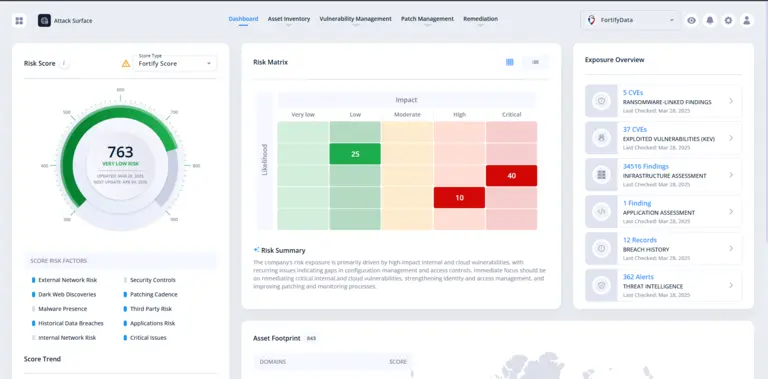
FortifyData is built on an active assessment model. The difference isn’t a feature. It’s a methodological foundation that changes what the platform can tell you and what evidence it can produce.
FortifyData conducts continuous live scans of vendor attack surfaces rather than aggregating signals from external data feeds. Vendor risk ratings reflect what exists in the vendor’s security posture at the time of assessment. Not what was detectable from third-party sources at some earlier point. Risk ratings can be weighted and customized by vendor or vendor tier, so your highest-risk vendors receive scrutiny proportional to the risk they represent.
When a vendor responds to a questionnaire, their answers are automatically cross-referenced against FortifyData’s live technical assessment data for that vendor’s environment. Contradictions between what a vendor claims and what their environment actually shows are flagged automatically, without a human analyst having to manually correlate two separate data sources.
This is the capability that passive ratings platforms cannot replicate: the rating observes external signals, but it doesn’t know what the vendor told you in their questionnaire. Auto-validation closes that gap by treating both inputs as part of the same assessment workflow.
FortifyData’s AI Auditor reviews vendor documents. SOC 2 reports, HECVATs, SIG questionnaires, compliance artifacts. It reviews them against the control intentions of the framework your organization is accountable to. HIPAA, NIST 800-53, NIST CSF, SOC 2 Trust Service Principles. The framework is the client’s choice. Every finding is cited back to the source document so your team can act on conclusions it can defend to auditors.
For higher education institutions, the AI Auditor interprets the HECVAT workbook natively, auditing across its multi-tab structure against its own control framework rather than treating it as a document to route.
Pima Community College reduced vendor report review time to under 2% of previous effort using FortifyData’s AI Auditor, replacing a multi-day manual review process for each SOC 2 and HECVAT submission with an automated audit against their chosen compliance frameworks.
Identifying a vendor risk is the beginning of the work, not the end. FortifyData builds remediation guidance directly into the assessment workflow. Prioritized action plans against your SLAs, with findings moving into a documented remediation path your team can track and demonstrate to auditors as evidence of active, ongoing vendor oversight. Risk findings don’t sit in a dashboard. They move toward resolution.
TPRM, attack surface management, and compliance automation run natively in one platform on the same live data model. For organizations currently running SecurityScorecard alongside a separate TPRM tool and a separate vulnerability management solution, FortifyData replaces all three with a single platform that doesn’t require integration to make its own capabilities work together.
Understanding that a vendor is high-risk is one thing. Understanding that seven of your top vendors all rely on the same underlying infrastructure provider, and that a single failure cascades across your entire ecosystem, is a different order of visibility.
FortifyData’s fourth-party risk concentration map is a force-directed graph that visualizes your third parties and connects the underlying vendors those third parties share. Concentration risks that would never surface in a per-vendor assessment become immediately visible: single points of failure, shared dependencies, and the interconnected exposure that defines modern supply chain risk.

The table below reflects capabilities as documented across independent comparison sources and each vendor’s public materials.
| Feature | SecurityScorecard | FortifyData |
|---|---|---|
| Assessment methodology | Passive. Externally observed signals, third-party data feeds, and aggregated OSINT. No direct probing of vendor environments. | Active. Continuous live scans of vendor attack surfaces. Findings reflect the current environment, not historically observed signals. |
| Data freshness | Data originates from public internet signals and third-party feeds rather than direct vendor scans. The freshness of any finding depends on when that signal was last observed externally, not when the vendor's environment was last assessed. | Current at time of assessment. Live scans surface what exists in the vendor environment now, not what was last observable from public internet sources. |
| Attribution accuracy | IP-range and domain-based attribution. Shared infrastructure, cloud hosting, and CDN environments create known misattribution risk. | Direct scan attribution reduces misattribution risk. Findings are tied to confirmed vendor assets rather than inferred from IP ranges. |
| Questionnaire management | Available via the Atlas questionnaire platform with vendor collaboration and response tracking. | Yes. Custom questionnaires, AI-automated answers, task management, and collaborative vendor workflows. |
| Questionnaire auto-validation against live data | Not offered. Questionnaire responses and rating data exist as separate inputs, not cross-referenced outputs. | Yes. Vendor questionnaire responses are automatically cross-referenced against live assessment findings. Contradictions between claims and environment are flagged automatically. |
| AI document review | AI capability (HEID) primarily supports the MAX managed service tier. Availability and depth for standard plans is limited and it is not a dedicated document auditing capability. | Yes. AI Auditor reviews SOC 2 reports, HECVATs, SIG questionnaires, and compliance documentation. Maps findings to client-chosen frameworks with citations back to source material. |
| AI framework flexibility | Framework templates available. Document analysis is not mapped to a client-chosen compliance framework. | Audit any document against any chosen framework. HIPAA, NIST 800-53, NIST CSF, SOC 2 TSP, HECVAT. The framework is the client's choice, not a platform default. |
| Remediation guidance | Risk findings surfaced via dashboard. Prioritized remediation action plans are not natively included. | Yes. Prioritized remediation action plans built into the assessment workflow. Findings move into a documented remediation path trackable against SLAs. |
| Auto-detected third parties from live scans | Not offered. Vendor list is manually maintained or imported. | Yes. Third parties are automatically surfaced through live technical assessment scans. Vendor ecosystem stays current without manual maintenance. |
| Fourth-party / supply chain concentration map | Supply chain risk detection available as a product feature. | Yes. Force-directed graph surfaces single points of failure and shared infrastructure dependencies across the full vendor ecosystem natively. |
| Platform scope | Security ratings plus supply chain detection plus questionnaire management via Atlas. Primarily a ratings platform with adjacent workflow features. | TPRM plus ASM plus Cyber GRC. Consolidated platform where all capabilities run on the same live data model without integration between separate tools. |
| Compliance framework mapping | Framework templates available. Compliance mapping depth is tied to passive signal data. | Yes. Compliance gap reporting against HIPAA, NIST CSF, NIST 800-53, ISO 27001, PCI DSS, SOC 2, and more. Findings based on live assessment data. |
| Audit defensibility | Score and dashboard output. Passive methodology not designed to satisfy auditor requests for documented assessment processes and validated vendor evidence. | Yes. Active assessment methodology, auto-validated questionnaire responses, and AI-cited document findings produce the documented evidence trail regulators and auditors expect. |
| Scoring methodology transparency | Methodology described at a category level. Weighting details are not fully public. | Risk scoring assessment methodology is publicly available. |
| Pricing model | Enterprise, custom pricing. Free tier available for limited use. | Mid-market focused. Contact for pricing. |
Pima Community College reduced vendor report review time to under 2% of previous effort using FortifyData’s AI Auditor, replacing a multi-day manual review process for each SOC 2 and HECVAT submission with an automated audit against their chosen compliance frameworks.
“One of the biggest reasons we chose FortifyData is the ability to do fresh scans for our third parties, and the scans are not based on any legacy data.” — Mortgage Lender Customer
If your current vendor risk program is built on a passive rating and you’re being asked by auditors, regulators, or your own team to demonstrate more, FortifyData is built to close that gap without adding tools or headcount.
Request a demo to see active vendor assessment, questionnaire auto-validation, and the AI Auditor working together as an integrated program.
Other Resources:
Watch the AI Auditor Demo
Third-Party Risk Management Platform
Attack Surface Management
BitSight Competitors
SecurityScorecard generates scores from passively collected external signals. Third-party data feeds, aggregated OSINT, and publicly observable domain and IP activity. It does not actively probe vendor environments or conduct direct technical assessments. This creates two practical limitations for compliance-driven programs: because findings originate from public internet signals rather than direct vendor scans, the freshness of any finding depends on when that signal was last observed externally, not when the vendor’s environment was last assessed; and attribution can be inaccurate, particularly where vendors share IP infrastructure, use cloud hosting, or operate through CDN environments. For regulated industries where auditors expect documented assessment processes, validated questionnaire responses, and ongoing monitoring evidence, a passive score does not satisfy that burden of proof.
FortifyData replaces the passive rating model with continuous active attack surface assessment of vendor environments. Where SecurityScorecard reports externally observable signals, FortifyData actively scans vendor environments and cross-references those findings against vendor questionnaire responses, automatically surfacing contradictions between what a vendor claims and what the assessment finds. The platform also includes AI Auditor for reviewing SOC 2 reports, HECVATs, SIG questionnaires, and compliance documentation at scale, mapping findings to client-chosen frameworks with citations back to source material. TPRM, attack surface management, and compliance automation run in a single consolidated platform rather than as separate tools.
SecurityScorecard’s passive methodology attributes risk signals based on IP ranges and domain associations. In environments where vendors share infrastructure, cloud hosting providers, CDN networks, shared data center space, signals from one organization can be attributed to another. The result is risk findings that reflect another entity’s posture rather than the vendor being assessed. Correcting a misattribution through SecurityScorecard’s dispute process can take weeks or months, during which the inaccurate signal continues to affect a vendor’s score. FortifyData’s active scan methodology attributes findings to confirmed vendor assets directly, reducing this class of error.
Organizations in regulated industries, financial services operating under DORA, FFIEC, NCUA, NYDFS, or GLBA; healthcare under HIPAA or HITRUST; higher education under GLBA, need a vendor risk program that produces documented, auditable evidence of ongoing oversight, not a score. FortifyData is built for that requirement. Its active assessment methodology, questionnaire auto-validation against live technical findings, and AI-powered document review produce the defensible evidence trail that regulators and auditors expect. SecurityScorecard’s passive platform was not designed to meet that bar.
FortifyData is designed to replace the passive rating model entirely rather than supplement it. For organizations whose vendor risk program is currently built around a SecurityScorecard score, FortifyData provides a complete alternative that handles continuous vendor monitoring, questionnaire management and auto-validation, AI document auditing, and compliance framework mapping in one platform. For teams being asked by auditors, regulators, or boards to demonstrate more than a rating, documented assessment processes, questionnaire evidence, and ongoing monitoring, FortifyData addresses those requirements directly.
The most important evaluation question is whether a platform validates what vendors claim against what is actually detectable in their environment. Passive platforms observe external signals; they cannot confirm that a vendor’s questionnaire responses are accurate or that a known vulnerability has been remediated. Key capabilities worth evaluating: active attack surface assessment of vendor environments, automated cross-validation of questionnaire responses against live technical findings, AI-powered review of compliance documentation including SOC 2 reports and HECVATs, framework mapping with source citations, and a publicly available scoring methodology. FortifyData delivers all of these in a single consolidated platform.