What is Cloud Security Posture Management (CSPM)?
Cloud Security Posture Management is the continuous monitoring and assessment of cloud infrastructure configurations to identify misconfigurations, compliance violations, and security risks before they result in incidents or regulatory findings. CSPM tools scan cloud accounts across providers such as AWS, Azure, and Google Cloud, evaluate each resource against security best practices and compliance framework requirements, and surface prioritized findings with remediation guidance. Unlike periodic cloud security assessments, CSPM operates continuously so that configuration drift and new misconfigurations are detected as they occur rather than discovered during an audit.
What cloud environments does FortifyData’s CSPM monitor?
FortifyData monitors AWS, Azure, Google Cloud, and Oracle Cloud continuously for misconfigurations, compliance violations, and security posture risks. Findings are surfaced in a unified risk dashboard alongside external attack surface and vendor risk data, providing a consolidated view of cloud and non-cloud exposure in a single platform.
How does CSPM relate to Attack Surface Management?
ASM and CSPM address adjacent but distinct problems. External ASM discovers and monitors internet-facing assets including domains, IP addresses, exposed services, and unknown assets for vulnerabilities and exposures visible from outside the organization. CSPM monitors the internal configuration of cloud environments including IAM policies, storage settings, encryption configuration, and network security groups for misconfigurations that create risk regardless of external exposure. FortifyData integrates both capabilities in the same platform so cloud configuration risk and external attack surface exposure are visible together rather than in separate tools.
Does FortifyData’s CSPM map findings to compliance frameworks?
Yes. FortifyData maps cloud security posture findings to relevant compliance framework controls including NIST CSF, CIS Benchmarks, PCI DSS, HIPAA, and GDPR. This means misconfiguration findings connect directly to the compliance controls they affect, providing a clear view of which findings have regulatory implications and which are security best practice violations without a direct compliance framework mapping.
What types of misconfigurations does FortifyData’s CSPM detect?
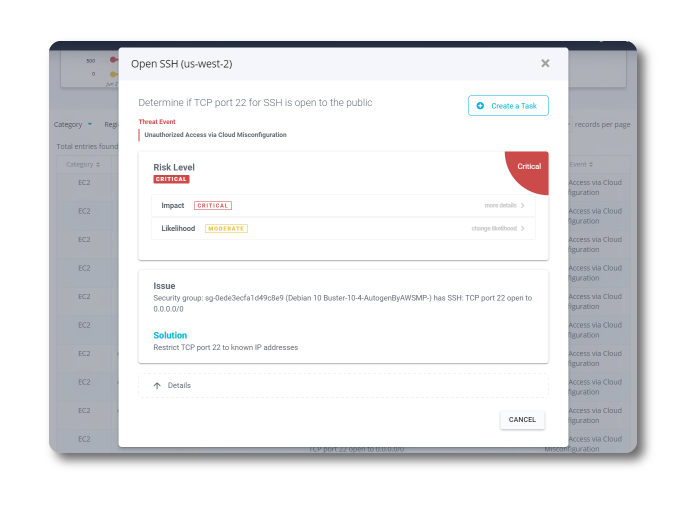
FortifyData detects misconfigurations across IAM and access management including overprivileged roles, missing MFA, and unrotated access keys; data storage including unencrypted storage, publicly accessible buckets, and misconfigured backups; network security including overpermissive security groups and unnecessary open ports; compute configuration including misconfigured virtual machines and serverless functions; and encryption and key management. Findings are risk-scored and prioritized so security teams focus remediation effort on the highest-severity issues first.
How is FortifyData’s CSPM different from standalone CSPM tools?
Standalone CSPM tools provide cloud configuration monitoring in isolation. FortifyData’s CSPM integrates cloud posture findings into the same platform as external attack surface management, third-party risk monitoring, and compliance management. Cloud risk is visible alongside vendor risk and external exposure in a unified risk register rather than a separate tool requiring separate workflows and manual reconciliation with the rest of the security program. For organizations already managing ASM or TPRM through FortifyData, CSPM adds cloud posture visibility without adding another tool.