Automate Healthcare Cyber Risk Management

The healthcare industry constantly faces challenges in managing the risk around healthcare IoT, securing protected health information (PHI), enabling telehealth as both covered entities (CE) and their business associates (BA) strive to enable health and medical services in a quickly changing threat landscape.  

The critical infrastructure that our healthcare system provides is increasingly targeted by threat actors due to the concentration of protected health information and sprawling technology networks.  

Manage Cyber Risk and Compliance in One Comprehensive Platform

Healthcare security teams operate under a distinct set of pressures. HIPAA requires ongoing risk analysis, not a one-time assessment, and OCR has consistently enforced against organizations whose risk management programs were inadequate or whose business associate oversight failed to catch third-party incidents before they became breaches. HITRUST certification is increasingly required by business partners and health systems as a condition of doing business. And the proposed HIPAA Security Rule updates, expected to take effect in 2027, shift several controls from “addressable” to “required.” Meaning organizations that have treated those controls as optional will need to act.

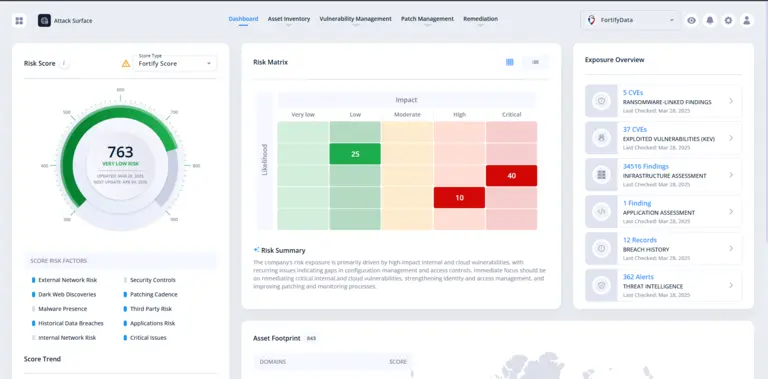
FortifyData dashboard 2026

FortifyData’s platform helps healthcare organizations manage this landscape in one system. Security and risk teams can continuously assess their external attack surface, manage business associate cyber risk with auto-validated questionnaires backed by live technical assessments, and track compliance posture against HIPAA, HITRUST, and other applicable frameworks without adding headcount or replacing existing workflows.

Why Healthcare Organizations Institutions Choose FortifyData

  • Direct, non-intrusive scanning of confirmed IT assets produces findings that are current, correctly attributed, and defensible when OCR or auditors ask how you verified your vendors’ security posture
  • Business associate risk assessments backed by live technical data, not questionnaire responses alone; auto-validation cross-references what vendors say against what direct scanning finds
  • Risk prioritization by department, subsidiary, or business associate. So security teams can focus on what actually matters rather than managing a flat list of vulnerabilities across a complex environment
  • HIPAA and HITRUST compliance tracking in the same platform as technical risk data; no separate GRC tool required
  • Continuous monitoring rather than point-in-time snapshots. The data underlying your risk program reflects the current state of your environment, not what it looked like at last year’s assessment
  • Purpose-built for organizations that need enterprise-grade capability without enterprise complexity or cost

Solutions for Healthcare Organizations

blank

Attack Surface Management and Risk-based Vulnerability Management 

Starting with asset discovery and inventory, our Attack Surface Management (ASM) identifies your IT assets as an attacker will. FortifyData assesses all ports and services, in a non-intrusive manner, of the healthcare organization’s external and internal attack surface and identifies the same vulnerabilities an attacker would. Our prioritization capabilities help you cut through the noise and get a view of the vulnerabilities with the most impact that actually matters; you can view this across the entire healthcare organization or by specific department or business associate. You get a prioritized risk approach that considers context through asset classification, threat likelihood, and business impact, so you know where

to focus time and resources on the most critical vulnerabilities to your organization. 

The proposed HIPAA Security Rule updates include explicit requirements for technology asset inventory and vulnerability identification — FortifyData’s continuous external and internal assessments are built to satisfy both.

blank

HIPAA, HITRUST, and the proposed Security Rule updates

HIPAA compliance is not a checkbox. OCR’s enforcement history makes clear that organizations need to demonstrate ongoing, documented risk management activity, not a completed risk assessment from three years ago sitting in a folder. The proposed HIPAA Security Rule updates, released in January 2025 and expected to take effect in 2027, introduce specific new requirements including technology asset inventory, network segmentation, multi-factor authentication, and encryption of ePHI at rest and in transit. Several controls previously classified as “addressable” are proposed to become “required.”

FortifyData maps platform findings directly to HIPAA Security Rule safeguards and HITRUST control categories, New York hospitals are also subject to 10 NYCRR 405.46, giving security teams a current view of their compliance posture rather than a static report that ages immediately after completion. For organizations pursuing HITRUST certification, FortifyData’s continuous assessment data provides the evidence base that certification requires.

Read our guide to HITRUST certification and our analysis of the proposed HIPAA Security Rule updates for a deeper look at what these changes mean for your program.

blank

Third-Party Cyber Risk Management 

Effectively evaluate a vendor and the specific service or product a vendor provides.

Gain visibility into the cyber risks of your business associates and third parties with continuous assessments of their external assets. We integrate our technology assessment findings to our embedded standard compliance or custom questionnaires to perform auto-validation that saves time in reviewing responses. Keep up to date on the compliance of your business associates with your policies, and quickly identify vendors that do not comply. Get the full picture of external vulnerabilities at your third parties with our auto-validated questionnaires that leverage the live assessment data conducted on their environment. This provides you with the answers you need more quickly (in the time to run an assessment) than a manual questionnaire process. Create custom questionnaires that are specific to each vendor.

Speed up vendor evaluations by spending less time reviewing questionnaires with FortifyData’s Questionnaire Exchange. Participants instantly access shared validated cyber risk assessments and questionnaires, allowing you to quickly make risk based decisions.

OCR has specifically cited inadequate business associate management as a contributing factor in enforcement actions. Covered entities that cannot demonstrate active, continuous oversight of their BA risk posture face elevated enforcement exposure; particularly as the proposed HIPAA Security Rule updates strengthen BA oversight requirements.

What FortifyData does differently in healthcare

Most cyber risk tools assess your vendors the same way an outsider would, by observing what is publicly visible from the internet.

FortifyData conducts weekly direct, non-intrusive scans of confirmed IT assets, with asset ownership verified before assessments run. For business associate risk management, that distinction matters: the data underlying your BA risk program reflects the current state of each vendor’s environment, not a self-reported questionnaire or an externally derived score that may include findings from a different organization sharing the same IP range.

For healthcare organizations managing dozens or hundreds of business associates, that data quality difference is the gap between a program that satisfies an OCR audit and one that does not hold up when examined at the finding level.

FortifyData combines attack surface management, business associate risk management, and compliance tracking in a single platform — so the same live assessment data feeds your vendor risk scores, your compliance posture tracking, and your internal vulnerability prioritization, rather than requiring three separate tools with three separate data sets that may tell different stories about the same environment.

Related Resources

A Comprehensive Guide To Achieving HITRUST Certification

HHS' Proposed HIPAA Security Rule Updates

Top Third-Party Data Breaches

Frequently asked questions about healthcare cyber risk management

What does HIPAA require for cyber risk management in healthcare organizations?

HIPAA’s Security Rule requires covered entities and their business associates to conduct ongoing risk analysis and risk management — not a one-time assessment. Organizations must identify and assess risks to electronic protected health information, implement security measures sufficient to reduce those risks to a reasonable level, and document their risk management activities. OCR has enforced against organizations that conducted risk analyses but failed to act on findings, as well as against those whose risk analyses were insufficiently comprehensive. The proposed HIPAA Security Rule updates expected in 2027 will strengthen these requirements further, including introducing specific mandates for technology asset inventory, vulnerability identification, and network segmentation.

How does FortifyData help healthcare organizations manage business associate risk?

FortifyData conducts direct, non-intrusive scans of business associates’ confirmed external IT assets on a continuous basis, producing live technical assessment data rather than relying on self-reported questionnaire responses alone. The platform’s auto-validation feature cross-references what vendors report in questionnaires against what direct scanning finds in their environment — identifying discrepancies that manual questionnaire review would miss. Covered entities can monitor multiple business associates simultaneously, receive alerts when BA security posture changes between assessments, and maintain an auditable record of BA oversight activity that can be produced in response to OCR inquiries or audits.

What are the proposed HIPAA Security Rule updates and how do they affect healthcare security programs?

HHS released proposed updates to the HIPAA Security Rule in January 2025 — the first substantial proposed changes since the Omnibus Rule in 2013. The proposed updates shift several controls from “addressable” to “required,” meaning organizations that have treated those controls as optional will need to implement them. Specific proposed requirements include technology asset inventory and network mapping, annual vulnerability scans and penetration testing, multi-factor authentication, encryption of ePHI at rest and in transit, and strengthened business associate oversight requirements. The rule is expected to take effect in 2027, giving organizations a limited window to assess their current posture against the proposed requirements and begin closing gaps.

How does FortifyData support HITRUST certification?

HITRUST certification requires organizations to demonstrate that security controls are implemented, operational, and measurable against defined criteria. FortifyData’s continuous assessment approach provides the ongoing technical evidence that HITRUST certification requires — asset inventory data, vulnerability assessment findings, and control effectiveness documentation that reflects the current state of the environment rather than a point-in-time snapshot. For organizations pursuing HITRUST r2 certification, FortifyData’s platform maps assessment findings to HITRUST control categories, reducing the manual evidence collection burden and providing auditors with current, attributable data rather than documentation assembled specifically for the certification review.

What is the difference between a point-in-time risk assessment and continuous monitoring for healthcare?

A point-in-time risk assessment reflects the state of an organization’s environment on the day the assessment was conducted. In healthcare environments where technology, vendors, and threat landscapes change continuously, a point-in-time assessment becomes outdated immediately after completion. OCR’s enforcement record includes cases where organizations had completed risk assessments but experienced breaches through vulnerabilities or vendor relationships that changed after the assessment was finalized. Continuous monitoring maintains an ongoing view of the organization’s risk posture — including business associate environments — so that changes in vendor security, newly discovered vulnerabilities, or configuration drift are identified as they occur rather than at the next scheduled assessment cycle.

How does FortifyData’s approach differ from other healthcare cyber risk management tools?

Most cyber risk tools assess vendor and organizational security posture using externally observable signals — what can be seen from outside the environment without direct access. FortifyData conducts direct, non-intrusive scans of confirmed IT assets, with asset ownership verified before assessments run. This eliminates the misattribution problem common in ratings-based tools, where findings from a shared hosting environment or cloud infrastructure are attributed to the wrong organization. For healthcare organizations where HIPAA requires defensible, accurate risk data, the difference between a score derived from external signals and findings produced by direct assessment of confirmed assets is the difference between data that satisfies an OCR inquiry and data that does not.