
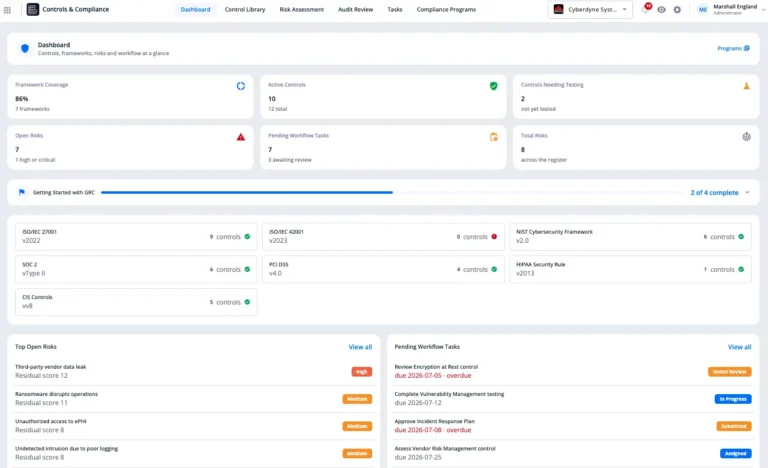
Compliance Management, Backed by Live Data

compliance management grc dashboard

Compliance management isn’t a new category. It’s existed for decades, long before “cyber GRC” was a term anyone used and part of your security posture management. What’s changed is what it takes to actually prove it. Most compliance tools today automate the paperwork: policy templates, task reminders, audit checklists, evidence folders. Far fewer verify whether the security behind that paperwork is still holding up in between assessments.

That gap is where FortifyData operates. It brings continuous, scan-verified security data into your compliance program, so what you show an auditor, a customer, or your own board isn’t just documented. It’s demonstrably true right now.

The rest of this page walks through where compliance programs typically get stuck, and what a live-data approach to compliance management changes at each stage.
Where Is Your Compliance Program Today?

Every compliance program looks different depending on where the organization is in its journey. The questions you’re asking, and the help you actually need, change as you move through it. Here’s roughly how that journey tends to break down.

Starting From Zero

You don’t have a framework yet, and something is forcing the issue: a customer asking for a SOC 2 report, a partner requiring ISO 27001, a board that wants to know what “compliance” actually means for your organization. This stage is less about technology and more about direction: what to pursue first, and how to get there without six months of confusion.

FortifyData supports this stage: control mapping, evidence organization, and framework guidance all apply from day one. But it’s the stages that follow where a continuous, scan-verified approach starts to change the equation in ways a checklist tool can’t.

Certified, But Reactive

You’ve passed your first audit. The certificate is real, but the program behind it isn’t. It comes to life once a year, right before the assessor’s visit, and quietly stops mattering the other eleven months. This is the most common failure point in compliance programs, and it’s rarely visible until something breaks: a control that was documented as configured turns out not to have been enforced for months.

This is where FortifyData’s approach is different. A control that’s documented as configured isn’t the same as one that’s verified to be working right now. Most compliance tools only show you the first.

The technical security evidence behind your compliance program (vulnerability findings, attack-surface changes) is continuously scan-verified and flows into your compliance record automatically, without anyone uploading a screenshot or filling out a form. Here’s how that breaks down across evidence types:

Evidence type How it's handled today
Vulnerability & attack-surface findings Continuously scan-verified, flows in automatically
Policy documentation Centrally stored, organized, and tracked
Cloud configuration validation Centrally stored, organized, and tracked
Firewall/network screenshots Centrally stored, organized, and tracked
Background checks Centrally stored, organized, and tracked

This is close to what happened at Viedoc, a Sweden-headquartered clinical trials platform, when continuous vulnerability data helped cover new control requirements introduced by ISO 27001:2022 during recertification, without redoing evidence work that was already sitting in the platform. This case study provides more about their experience.

If the pressure you’re feeling is coming from your vendors rather than your own certification (a supplier that needs to prove compliance to you, not the other way around), that’s third-party risk management: a related but different discipline.

Multiple Frameworks, One Spreadsheet

SOC 2 for enterprise deals. ISO 27001 for the EU customer. HIPAA because health data entered the picture. PCI DSS because payments did too. Compliance stopped being a single framework a while ago for most growing organizations, but a lot of programs are still run like it is: separate spreadsheets, separate evidence folders, sometimes separate people, one set per framework.

FortifyData’s AI Auditor maps evidence once and applies it everywhere it’s relevant. A control that’s already validated for SOC 2 doesn’t need to be re-proven from scratch for ISO 27001 if it satisfies both. The platform carries the work forward instead of starting over.

Expanding Into New Ground

A new market. A new customer segment. A new regulation that didn’t apply last year but does now. Every one of these forces the same question: does the compliance work you’ve already done carry forward, or are you starting over?

Viedoc, a Sweden-headquartered SaaS provider building software for clinical trials research, went through this directly. With infrastructure spanning Europe, the US, China, and Japan, Viedoc’s CISO Predrag Gaic needed to recertify to the updated ISO 27001:2022 standard while new regulations, including NIS2 and DORA, were also coming into scope. Rather than treating each as a separate project, FortifyData’s threat analytics fed directly into covering the new ISO 27001:2022 requirements alongside the platform’s other modules, and left Viedoc positioned to work toward NIS2 and DORA on the same foundation rather than starting over for each one. Read the full case study.

One Risk Register, Not Three Disconnected Tools

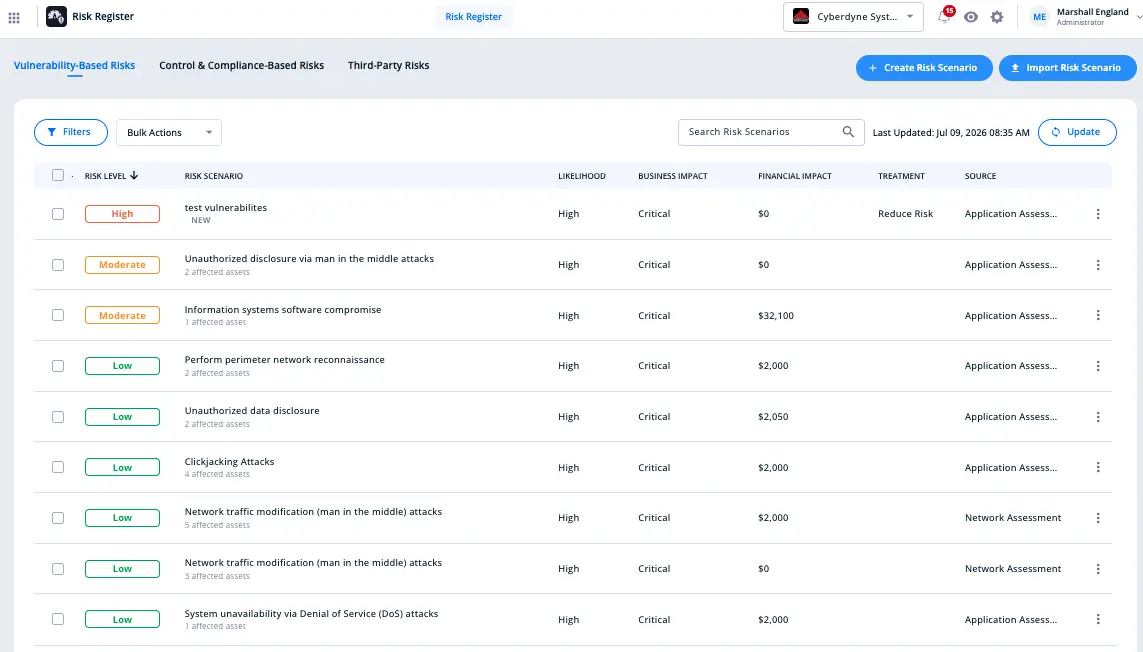
Here’s the harder-to-copy part of FortifyData’s story: not that it automates more evidence types than everyone else (it doesn’t try to claim that), but that findings don’t stay siloed once they’re in the platform.

Organizations running a separate TPRM tool, a separate attack-surface scanning tool, and a separate compliance-automation tool end up with three disconnected data sets, and reconciling them by hand or monitoring multiple integrations between everything becomes its own project(s), on top of the compliance work itself.

unified risk register dashboard

FortifyData’s Risk Register is what makes “consolidated platform” a concrete mechanism instead of a slogan. Attack-surface findings, third-party and vendor findings, and framework-specific assessment findings are all automatically migrated into a single Risk Register: no manual re-entry, no separate spreadsheet per module, no reconciling three tools before a board meeting.

As Viedoc’s CISO Predrag Gaic put it, describing the platform after consolidating multiple prior tools:

“It’s a one-stop shop where we can see everything.”

It’s the kind of thing that’s structurally difficult for a vendor to replicate if their ratings, TPRM, and compliance products were built and sold as three separate things.

IT Risk Management, Built on the Same Data

Compliance frameworks tell you what to prove.

Risk management tells you where to look first.

FortifyData treats these as one connected workflow instead of two separate tools: every finding from continuous attack surface scanning, vendor assessments, and framework-specific reviews feeds a live risk register, scored and prioritized by actual business impact, not a static spreadsheet updated once a quarter.

This matters beyond general good practice. Frameworks including the GLBA Safeguards Rule specifically require a documented, ongoing risk assessment; not a one-time exercise, and not the same artifact as your compliance evidence file. FortifyData supports building and maintaining that risk assessment directly from real assessment data, so it reflects current exposure rather than a snapshot from whenever it was last updated manually.

For teams managing multiple frameworks or business units, this also means one consistent risk methodology instead of reconciling separate risk models per framework, per department, or per audit cycle.

Also Part of the Compliance Management Platform

Compliance rarely lives in one dimension, and FortifyData covers a few adjacent pieces worth knowing about:

Privacy Assessment helps you evaluate privacy-specific risk alongside your security compliance work, rather than as a disconnected exercise run by a different team with a different tool.

Contract Management gives you a practical way to keep track of vendor and partner contracts (inventory, contract type, expiration dates, and renewal reminders) so agreements tied to your compliance obligations don’t quietly lapse. It’s a hygiene tool, not a full contract-negotiation platform, and it’s most useful paired with the compliance and vendor-risk work happening elsewhere in FortifyData.

Frameworks FortifyData Supports

Category Framework What it covers Common industries
Cross-industry baseline SOC 2 Security & availability attestation SaaS, tech vendors of any size
ISO 27001 Information security management Global/EU-facing SaaS, enterprise vendors
NIST CSF Security risk framework Cross-industry, US public-sector-adjacent
Healthcare HIPAA Healthcare data privacy & security Healthcare, health tech, business associates
HITRUST Healthcare-focused security certification Healthcare, health tech
Financial services & higher ed (US) GLBA Financial data safeguarding Higher education, financial services
PCI DSS Payment card data security Retail, e-commerce, card-handling orgs
Government & public sector FedRAMP Cloud security authorization for federal agencies SaaS/cloud vendors selling to US federal government
CMMC Defense supply chain cybersecurity certification Defense contractors, DoD supply chain
EU & international DORA Financial-sector operational resilience Financial services and their vendors (EU)
NIS2 Critical infrastructure & digital services cybersecurity Energy, transport, health, digital infra, manufacturing (EU)

Compliance By Industry

Every industry carries its own version of this problem. FortifyData’s approach to security posture assessments with continuous, scan-verified compliance applies across all of them, but the pressure points differ:

Higher Education programs are shaped heavily by the GLBA Safeguards Rule and the pressure of protecting student financial data across a sprawling, often decentralized IT environment. Read how to meet and how FortifyData can help meet GLBA Safeguards Rule requirements

Healthcare organizations are managing the changing HIPAA security rule and often HITRUST simultaneously, with patient data risk touching both internal systems and a wide network of business associates. 

Banks operate under regular FFIEC examinations, and vendor and technology risk oversight is one of the areas examiners scrutinize most closely, since so much of a bank’s infrastructure and data now sits with outside providers.

Credit Unions face similar scrutiny from NCUA examiners, particularly around the vendor relationships and outside service providers most credit unions depend on to operate.

Curious what a scan-verified compliance program would actually show you?

Let’s  walk you through it. Schedule a consultation.

Compliance Management Frequently Asked Questions

What is compliance management?

In cybersecurity and IT, compliance management is the ongoing process of proving your organization’s security controls actually meet the requirements of a framework or regulation, not just once at audit time, but continuously. It covers mapping controls to a framework like SOC 2 or ISO 27001, collecting and organizing evidence, and catching control drift before an auditor does. This term is also used outside cybersecurity: banks and credit unions use “compliance management system” for board-level consumer-protection oversight, and HR teams use it for policy and training compliance. This page is about compliance management for security, IT, and GRC teams.

How is compliance management different from third-party risk management (TPRM)?

Compliance management is about your own organization’s controls meeting a framework’s requirements. Third-party risk management is about the vendors and partners you rely on meeting yours. The two overlap (frameworks like DORA, HIPAA, and GLBA often require you to prove your vendors are compliant too), but they’re different disciplines with different owners and different day-to-day work. See FortifyData’s third-party risk management page for the vendor-facing side of this.

What’s the difference between getting certified and staying compliant?

Certification proves your controls worked on the day of the audit. Staying compliant means they still work the other 364 days of the year. Most compliance programs are built to pass an audit, not to catch the policy that went stale or the control that quietly stopped enforcing three months after the assessor left. That gap between audit day and the rest of the year is where FortifyData focuses: the security evidence behind your compliance program is verified on an ongoing basis, not just checked once a year.

Does compliance management software automate all evidence collection?

It depends on the platform and the type of evidence. FortifyData continuously verifies the technical security evidence behind your compliance program: vulnerability and attack-surface findings flow in automatically, scan-verified, without anyone uploading a screenshot. A control that’s documented as configured isn’t the same as one that’s verified to be working right now. Most compliance tools only show you the first. It’s worth asking any platform you’re evaluating which one they actually give you.

What compliance frameworks does FortifyData support?

FortifyData supports NIST CSF, ISO 27001, SOC 2, HIPAA, GLBA, DORA, PCI DSS, HITRUST, and other major frameworks, with control mappings that carry forward as you add new frameworks, so a first SOC 2 report doesn’t have to be redone from scratch when ISO 27001 comes next.