
Why TPRM Has Never Mattered More
Your vendors are your extended attack surface. According to the 2025 Verizon Data Breach Investigations Report, third-party involvement was linked to 30% of all breaches — double the prior year. Regulations like DORA, GLBA, and HIPAA now require organizations to demonstrate continuous, defensible oversight of their supplier ecosystem, not just an annual questionnaire or spreadsheet review.
To meet that challenge, many organizations turned to Prevalent, one of the earlier dedicated TPRM platforms on the market.
Teams evaluating away from Prevalent often have UpGuard on the same shortlist — if that’s your situation, there’s a dedicated UpGuard alternative comparison that covers where those two platforms diverge on AI auditing and compliance framework depth. But since Mitratech acquired Prevalent in October 2024, many wonder: Is there a better option?
This guide breaks down what Prevalent offers, where it falls short based on real user feedback, and why FortifyData has become a compelling, and in most cases, superior, alternative for third-party risk management.
What Is Mitratech Prevalent?
Prevalent is a third-party risk management platform that has been part of the TPRM market for over two decades. In October 2024, it was acquired by Mitratech, a legal, risk, and HR compliance technology company that has now made more than 24 acquisitions across its portfolio; so where is Prevalent’s priority among those internal integrations?
Key Features
Prevalent’s platform is built around several core capabilities:
- Questionnaire-based risk assessments. This is Prevalent’s foundational approach. The platform provides a large library of pre-built questionnaires aligned to frameworks like ISO 27001, NIST, HIPAA, SOC 2, and SIG, and allows organizations to send these to vendors for self-assessment. Vendors complete assessments via a portal, and results feed into a risk register.
- Continuous threat monitoring. Prevalent supplements questionnaires with external monitoring across five risk domains — data, brand, financial, operational, and regulatory. This includes alerts triggered by events like phishing detections, lawsuit filings, and credit score changes.
- Automated document analysis. More recently, Prevalent introduced automated document analysis (ADA) using NLP and machine learning to check uploaded vendor evidence against keyword criteria, reducing the need to manually review supporting documents question by question.
- Vendor Risk Networks. Prevalent operates shared assessment networks in verticals like healthcare and financial services, allowing vendors to complete an assessment once and share it across multiple customers.
- AI enhancements. Since the Mitratech acquisition, Prevalent has introduced AI-assisted features including auto-population of questionnaires from prior Excel files and an AI assistant (“Alfred”) for platform navigation.
The Challenges with Prevalent
Despite its capabilities, consistent patterns emerge in user reviews on Gartner Peer Insights and G2 that are worth understanding before making a buying decision.
Questionnaires remain the core — and the bottleneck. Even with automation improvements, Prevalent’s workflow is fundamentally organized around sending, chasing, and processing questionnaire responses.
One Gartner reviewer put it directly:
“Unfortunately, it still requires your vendors to do some lifting, which is where things always fall down in the process.”
Questionnaire fatigue is real for vendors, and delayed or incomplete responses create blind spots.
Complex onboarding and a steep learning curve. Multiple users across G2 and Gartner describe the platform as difficult to get up to speed on. One G2 reviewer noted:
“The platform is very complex, and the onboarding process for the tool was overwhelming for us, as we were completely new to this process. The GUI and system could also be easier to use and more intuitive.”
Another Gartner reviewer described the product as
“very clunky with a dated UI/UX” and noted that “several basic functionalities and customisations are unavailable.”
Inflexible reporting. Users frequently cite limitations in how data can be surfaced and exported. One reviewer noted being forced to export schedule reports to Excel just to analyze certain aspects of the process — defeating the purpose of a dedicated platform. Others specifically mentioned that dashboards cannot be customized to show only what’s relevant to their role.
Vendor portal friction. Gartner reviewers flagged that vendor users cannot see others from their own organization in the portal, cannot remove users themselves, and encounter unclear file upload workflows when completing tasks. These friction points slow down the very collaboration Prevalent is designed to enable.
Post-acquisition uncertainty. Mitratech has executed over 24 acquisitions across GRC software, legal tech, and HR technology. When any product is absorbed into a large, multi-product portfolio, questions about roadmap prioritization, support focus, and long-term product investment are legitimate. Teams evaluating Prevalent today are evaluating it as part of a much larger corporate entity — not the focused, independent TPRM company that built the product.
What Is FortifyData?
FortifyData is a Cyber GRC platform purpose-built for cybersecurity teams — unifying third-party risk management, attack surface management, vulnerability management, and compliance automation in a single platform. Its TPRM application goes beyond the questionnaire-centric model by leading with continuous, active monitoring of vendors’ external attack surfaces and layering in AI-powered SOC 2 and other report analysis, and AI workflow automation on top of traditional questionnaire management.
Key Features
Continuous external attack surface monitoring. Rather than waiting for the next assessment cycle, FortifyData continuously scans vendors’ internet-facing assets for vulnerabilities, misconfigurations, open ports, TLS/SSL issues, and dark web exposures. This gives teams live intelligence on vendor risk posture between formal assessments — not just a snapshot at the time a questionnaire was sent.
AI Auditor for vendor reports. FortifyData’s AI Auditor allows teams to upload SOC 2, HECVAT, SIG, and other vendor security documents and receive an intelligent audit against selected frameworks including NIST, ISO 27001, and CIS Controls. The AI generates a dashboard identifying gaps and control deficiencies, with page-specific citations from the original document — no manual line-by-line review required.

Agentic AI workflow automation. FortifyData’s AI vendor engagement agent autonomously handles outreach, sends context-aware follow-up questions, requests missing documentation, highlights non-compliance, and sends status reminders to vendors — dramatically reducing the administrative chase work that consumes most TPRM teams’ time. This is the future of TPRM to build an efficient and scalable program.
Questionnaire support (when you need it). FortifyData supports questionnaire-based assessments and auto-validates responses against live external data, closing the gap between what vendors claim and what is actually observable. Questionnaires are a tool in the workflow, not the entire workflow.
Unified Cyber GRC. For organizations that also need internal risk management, compliance automation (GLBA, HIPAA, HITRUST, ISO 27001, CMMC, and more), or attack surface visibility for their own environment, FortifyData covers all of it in one platform — eliminating the need for multiple point solutions.
FortifyData vs. Mitratech Prevalent: Core Comparison
| Capability | FortifyData | Mitratech Prevalent |
|---|---|---|
| Primary assessment method | Continuous external attack surface + AI report audit + questionnaires | Questionnaire-first, with supplemental monitoring |
| AI capabilities | AI Auditor for SOC 2/HECVAT/SIG reports; agentic workflow automation | AI questionnaire population; Alfred navigation assistant |
| Continuous monitoring | Active vulnerability and attack surface scanning (not passive data) | Passive threat event monitoring (brand, financial, regulatory) |
| Vendor portal | Streamlined onboarding and evidence submission | Multi-step portal with known friction points for vendor users |
| Onboarding time | Rapid deployment; designed for immediate time-to-value | Complex implementation with steep learning curve per user reviews |
| Platform UI | Clean, user-friendly; praised for ease of use | Described as complex and dated by multiple reviewers |
| Reporting flexibility | Customizable dashboards and reporting | Rigid reporting; advanced filters cannot be saved |
| Platform scope | Full Cyber GRC: TPRM + ASM + Vuln Mgmt + Compliance | TPRM-focused; integrates with external GRC via API |
| Ownership | Independent, cybersecurity-focused company | Acquired by Mitratech (24+ acquisitions) in October 2024 |
| Frameworks supported | NIST, ISO 27001, SOC 2, HIPAA, GLBA, HITRUST, PCI DSS, CIS, CMMC | ISO 27001, NIST, CMMC, GDPR, SSAE 18, SIG, SOX, NYDFS |
Why Teams Choose FortifyData Over Prevalent
1. Faster Onboarding, Faster Value
Prevalent’s implementation requires significant upfront investment in configuration, training, and process-mapping. User reviews consistently describe the onboarding as overwhelming, particularly for teams new to formal TPRM programs. FortifyData is designed to deliver immediate value — the platform’s continuous monitoring begins generating vendor intelligence as soon as vendors are added, without requiring a fully designed questionnaire library to get started. Teams can get meaningful risk visibility within days, not months.
2. Easier to Use — for Your Team and Your Vendors
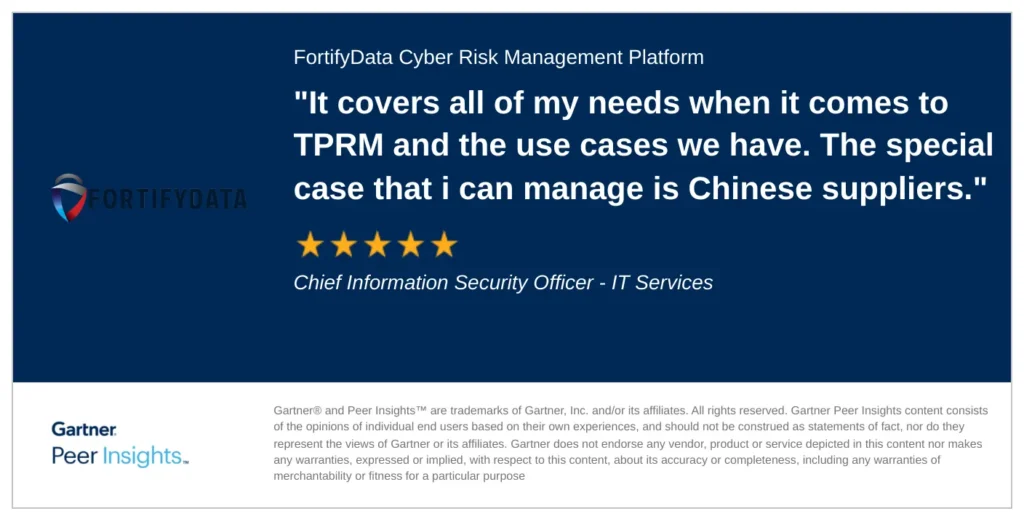
A TPRM platform that your team won’t use — or that your vendors find confusing — doesn’t reduce risk. FortifyData reviewers on Gartner Peer Insights describe it as straightforward to navigate, with responsive support and fast feature iteration based on customer feedback. One reviewer noted:
“The tool delivers a holistic review of the entire attack surface with zero setup. It doesn’t get easier than this.”
Critically, FortifyData’s vendor-facing workflows are designed to minimize friction, so vendors respond faster and more completely — reducing the chase work that eats up analyst time in questionnaire-heavy programs.
3. Real-Time Risk Visibility — Not Point-In-Time Snapshots
Questionnaires tell you what a vendor says about their security posture at a moment in time. FortifyData’s continuous external scanning tells you what is actually observable about their environment right now. If a vendor develops a critical vulnerability, exposes an open port, or has credentials appear on the dark web between assessment cycles, FortifyData surfaces it in real time — not at next year’s review. This shift from periodic compliance to continuous intelligence is fundamental to how modern TPRM programs should operate.

4. Smoother Vendor Collaboration
One of the most consistent criticisms of Prevalent from real users is the vendor portal experience — including the inability for vendor users to manage their own team members, unclear file upload workflows, and the general burden placed on vendors to “do the lifting.” When vendors find a platform difficult to work with, response rates drop and assessment quality suffers.
FortifyData’s agentic AI workflows autonomously guide vendors through the process — requesting the right documentation, following up contextually, and validating evidence automatically. The result is less email chasing for your team and less frustration for your vendors.
5. Better Value Across the Full Risk Picture
Prevalent is a point solution focused on the TPRM workflow. For organizations that also need attack surface visibility, internal vulnerability management, or compliance automation, that typically means purchasing and integrating additional tools. FortifyData consolidates those capabilities into a single platform — meaning fewer vendors to manage, fewer integrations to maintain, and a more accurate, unified view of your organization’s risk posture. For teams operating under budget pressure, that consolidation translates directly to cost savings.
6. Responsive, Cybersecurity-Focused Support
FortifyData is a cybersecurity-native company, and its support model reflects that. Customers consistently describe response times as fast and the team as genuinely invested in their success — including implementing feature requests faster than most enterprise vendors. As one Gartner reviewer put it: “Fortifydata has been excellent to work with. Response to any questions that I have is quick and informative.”
By contrast, Prevalent’s acquisition by Mitratech — a company managing 24+ products across legal, HR, and risk verticals — raises reasonable questions about where dedicated TPRM support and innovation will rank in the broader corporate priority stack.
Real Results: Pima Community College
When Lorenso Trevino, CISO and Director of Security at Pima Community College in Arizona, needed to scale his team’s third-party risk assessment process, FortifyData’s AI Auditor delivered immediate, measurable results. Before FortifyData, each SOC 2 or HECVAT review required six to eight hours of manual analysis. After deploying the AI Auditor, that time dropped to one to two hours per vendor — enabling analysts to evaluate multiple vendors per day without sacrificing accuracy.
Trevino noted that he personally validated the AI’s output against manual analysis on the first several reports before trusting it fully. The results matched, and the team now focuses their attention on the flagged concerns rather than reviewing the entire document from scratch — a more intelligent, defensible approach to vendor oversight.
This kind of efficiency gain isn’t theoretical. It’s what frees TPRM teams to cover more of their vendor portfolio, respond faster to emerging threats, and demonstrate a stronger program to auditors and leadership.
Read more details in the case study.
Make Third-Party Risk Management Simpler with FortifyData
If you’re evaluating Prevalent alternatives because your current program feels like it’s held together by questionnaire follow-ups, manual document reviews, and spreadsheet exports — you’re not alone, and you’re not stuck.
FortifyData was built to do the hard work for you. Continuous monitoring that never stops between assessments. AI that reads vendor reports so your analysts don’t have to. Workflows that chase vendors automatically. A unified platform that covers TPRM, attack surface management, and compliance without requiring five different tools.
The goal isn’t just a better platform. It’s a TPRM program you can actually defend to auditors, regulators, and your leadership team — one that scales with your vendor ecosystem instead of lagging behind it.
Ready to see what a modern TPRM program looks like?
Frequently Asked Questions
Is Prevalent still supported after the Mitratech acquisition?
Yes, Mitratech has stated that existing customers will continue to have access to their account managers, customer success managers, and support teams. However, Prevalent is now one of more than 24 products within Mitratech’s portfolio, spanning legal tech, HR, and GRC. Organizations should evaluate whether a TPRM product owned by a large, multi-vertical acquirer will continue to receive the same level of focused innovation and support they received from an independent vendor.
What are the main limitations of questionnaire-only TPRM?
Questionnaire-based assessments have two fundamental constraints: they rely on vendor self-reporting (which can be incomplete or inaccurate), and they are point-in-time snapshots that become stale the moment they’re completed. A vendor could pass a rigorous assessment in January and develop a critical vulnerability in February. A questionnaire-only program wouldn’t know until the next annual review. Modern TPRM programs combine questionnaires with continuous external monitoring to close that gap.
Does FortifyData still support vendor questionnaires if needed?
Yes. FortifyData supports questionnaire-based assessments and can map responses to major compliance frameworks including NIST, ISO 27001, SOC 2, HIPAA, PCI DSS, and more. The key difference is that questionnaires are one tool within a broader, continuous risk monitoring workflow — not the primary mechanism for risk intelligence. FortifyData also auto-validates questionnaire responses against live external scan data, so you can see whether a vendor’s self-reported controls match observable reality.
How long does it take to transition from Prevalent to FortifyData?
Transition timelines vary depending on vendor portfolio size and existing process maturity, but FortifyData is designed for rapid deployment. Because continuous monitoring begins generating intelligence immediately upon vendor onboarding — without relying on a fully built questionnaire to be deployed — teams typically begin seeing value within days. FortifyData’s team works closely with customers during migration to ensure continuity of existing vendor relationships and historical risk data.
What should organizations look for when evaluating a Prevalent alternative?
Organizations evaluating alternatives to Prevalent should look for continuous active assessment of vendor attack surfaces rather than reliance on questionnaire self-reporting, AI-powered document review that can audit SOC 2 reports and HECVATs at scale without analyst hours, auto-validation of vendor responses against live technical findings, compliance framework mapping to DORA, GLBA, HIPAA, and NIST built into the platform, and a vendor with focused TPRM innovation rather than a product embedded in a large multi-vertical portfolio. The acquisition of Prevalent by Mitratech places it alongside more than 24 products spanning legal tech, HR, and GRC. Organizations that need a dedicated TPRM platform with continuous development in that specific category should evaluate whether that focus will be maintained over time.