
Security posture is the collective state of an organization’s ability to identify, prevent, detect, and respond to cyber risk. At its full scope, that picture includes:
- Technical controls and configuration: how systems are set up, hardened, and maintained
- Vulnerability management: finding and addressing exploitable weaknesses before attackers do
- Threat detection: the ability to spot malicious activity as it happens
- Access control: who can reach what, and how authentication and privilege are managed
- Incident response: the plans and readiness to act when something goes wrong
- Policy and compliance: the documented rules a security program actually runs on
- The technology stack: the firewalls, EDR/XDR, encryption, and monitoring platforms that enforce all of the above
- Workforce awareness and training: how well people, not just systems, resist and report threats
That’s the full picture most authoritative sources point to when they define the term. No single vendor, including FortifyData, covers all of it, and it’s worth being direct about which parts FortifyData actually addresses rather than blending a convenient, product-shaped definition into the broader one above.
Why Security Posture Matters Beyond the Technical Picture
A strong technical security posture isn’t just a security team concern. It’s the foundation that makes compliance defensible. Frameworks like HIPAA, PCI DSS, and NIST CSF all assume the controls behind them actually work. It’s difficult to credibly demonstrate compliance on top of controls an organization can’t verify are functioning, which is why posture and compliance are more connected than they’re usually given credit for. (More on how FortifyData approaches this in compliance automation.)
For a CISO reporting to a board, a VP of IT trying to prioritize a lean team’s time, or an analyst deciding what to fix first, the practical value of understanding security posture clearly is the same: it turns “we think we’re probably fine” into something an organization can actually stand behind.
What FortifyData Covers for Security Posture Management
FortifyData strengthens security posture by continuously assessing an organization’s technical environment and its vendor ecosystem.
Within that full picture, FortifyData’s platform provides:
- Technical environment: continuous assessment and monitoring of technical controls, configuration, and vulnerability exposure
- Third-party and cloud risk: vendor risk assessment (see third-party risk management) and cloud environment monitoring (see cloud security posture management)
- Policy documentation: centrally stored, organized, and tracked (see compliance automation)
- Incident response readiness: centralized incident command, guided playbooks, and automated response workflows through the Incident Management module
Two distinctions worth being precise about. First, FortifyData isn’t part of the technology stack itself, it doesn’t replace the firewalls, EDR/XDR, encryption, or servers an organization already runs. It assesses and monitors the environment those tools operate within.
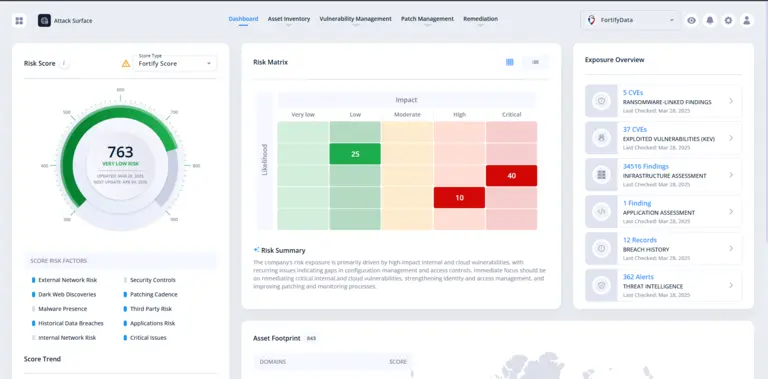
FortifyData also distills all of this into a security posture score, useful for summarizing a large amount of underlying data for a board or team at a glance. That baseline score reflects continuous, direct scanning rather than a once-a-year snapshot, and it’s fixed rather than manually adjustable; organizations that want a different lens can also build customizable scores by reweighting factors, which FortifyData’s scoring methodology covers in detail.
What Security Posture Assessment Actually Measures
A security posture assessment looks at the technical reality of an environment, not a self-reported survey of it. That typically includes:
- Technical controls and configuration: how systems are set up, hardened, and maintained
- Vulnerability exposure: what’s discoverable and exploitable from outside the organization
- Third-party and vendor risk: the posture an organization inherits from the vendors and partners connected to it (see third-party risk management)
- Cloud environments: misconfigurations, exposed storage, missing least-privilege policies, and other gaps specific to AWS, Azure, Google Cloud, and Oracle Cloud (see cloud security posture management)
- Incident response readiness: whether an organization can actually execute a response plan when something goes wrong, not just whether one exists on paper
That fourth-to-last point deserves emphasis, since cloud infrastructure is easy to leave out of a mental model of “security posture” built around on-prem assets and endpoints. It shouldn’t be. Cloud misconfiguration is one of the more common ways organizations end up with a posture that looks fine on paper and isn’t.
Isaac Abbs, CIO at Pima Community College, described this kind of gap directly: even with solid existing tools in place, a security assessment surfaced “major blind spots that those tools aren’t designed to capture,” because most tools are built to answer how do you respond once you’ve been exploited, not how do you see and minimize the attack surface before that happens. That’s the difference between knowing your posture and just hoping it’s fine.
See Your Security Posture, Not Just a Score
Understanding security posture accurately, continuously, and with visibility into what’s actually driving it is the difference between managing risk and guessing at it.
What does a security posture assessment actually involve?
FortifyData gives security and IT teams a continuous, direct view into their technical posture, without requiring a professional-services engagement to get value out of it. (For organizations that want that layer, it’s also available through FortifyData’s partner ecosystem of MSPs, MSSPs, and vCISOs.)
Request a Free Assessment to see where your organization’s external security posture actually stands.
Frequently Asked Questions About Security Posture
What does a security posture assessment measure?
Technical controls and configuration, vulnerability exposure, third-party/vendor risk, cloud environments (CSPM), and incident response readiness.
Why does security posture matter for compliance?
Frameworks like HIPAA, PCI DSS, and NIST CSF assume the controls behind them are actually working. A strong technical security posture is what makes compliance defensible, since it’s difficult to credibly demonstrate compliance on top of controls an organization can’t verify.
How often should security posture be assessed?
Continuously, where possible. Point-in-time assessments (annual audits, periodic scans) are already out of date the moment they’re complete, since configurations, vulnerabilities, and vendor relationships change constantly. A continuous view is what turns security posture from a once-a-year snapshot into something an organization can actually act on in real time.