IT Risk Management and Compliance Software for Community Banks

Community banks face the same examiner expectations as institutions with entire GRC departments. What they usually don’t have is the department. What they have instead is a person, sometimes two, and a set of spreadsheets holding the program together.

FortifyData exists for that gap: the same continuous risk and compliance visibility larger institutions build with a full team, sized for the one you’ve actually got.

Spreadsheets Are Free. The Hours Spent Chasing Them Aren't.

At most community banks, IT risk and compliance work is still happening in spreadsheets. Not because the team doesn’t know better, but because a one to three person security or compliance function doesn’t have the bandwidth to build or maintain anything more sophisticated, even when the regulatory expectations are the same as they are for a much larger institution.

It’s also common to see the work land on someone outside security or IT entirely. Vendor risk reviews, questionnaire tracking, and compliance documentation often get absorbed by whoever has the time, not necessarily whoever has the title. We regularly hear about non-IT and non-security staff, HR, operations, even finance, ending up responsible for pieces of the third-party risk process simply because someone has to own it.

This isn’t unique to security and IT risk either. The Federal Reserve’s own research on community bank compliance officers names the multiple-hats reality directly, along with the risks it creates: not enough time allocated to the role, potential conflicts of interest when the same person performs reviews of their own area, and the difficulty of building broad compliance knowledge quickly after moving over from a single-function role. It’s a regulator-acknowledged pattern across the compliance function broadly, not just a security team problem.

This isn’t a hypothetical small-team framing. It’s confirmed by the numbers:

Compliance cost category Smallest community banks Largest institutions
Personnel costs devoted to compliance 11% to 15.5% of payroll 6% to 10% of payroll
Consulting costs devoted to compliance 50% to 64% of consulting budget 19% to 30% of consulting budget

According to 10 years of data from the CSBS Annual Survey of Community Banks, compliance costs behave like a fixed expense rather than one that scales down with size, which means the smallest institutions absorb a disproportionate share regardless of how lean the team is. ICBA’s summary of the findings puts it plainly: community banks pay more for compliance, not because they’re less capable, but because the regulatory floor doesn’t move for institution size.

The Regulatory Landscape Community Banks are Managing

FFIEC guidance and NYDFS requirements, where applicable, have both moved toward continuous oversight expectations rather than annual snapshots.

GLBA Section 501(b), implemented for banks through the Interagency Guidelines Establishing Information Security Standards, mandates a documented risk assessment as a distinct requirement, not a byproduct of your compliance file.

IT Risk Management: Know What You're Carrying Before an Examiner Asks

Under GLBA Section 501(b), implemented for banks through the Interagency Guidelines Establishing Information Security Standards, a documented risk assessment is a distinct regulatory deliverable, not a summary pulled together from the compliance file after the fact.

Most community banks build this assessment once a year, disconnected from what’s actually changing across vendors, systems, and controls in between. FortifyData’s Risk Register scores and prioritizes risk from attack surface findings, third-party assessments, and framework gaps as they emerge, so a one or two person team isn’t rebuilding the risk picture from scratch every review cycle.

Compliance Management: Prove It, Don't Just Track It

Free to open. Expensive to defend.

A spreadsheet costs nothing to start. It costs hours, and credibility, when an examiner asks for evidence and the answer is scattered across tabs, email threads, and whoever’s memory is sharpest that week.

FortifyData consolidated cyber risk management platform unifies attack surface findings, third-party risk data, and framework mapping into the same Risk Register your team uses for risk assessment, so audit preparation isn’t a separate scramble built in the weeks before an exam. Policy status, control gaps, and supporting evidence live in one place, updated continuously rather than reconstructed under deadline.

Third-Party Risk Is Part of This, Not the Whole Story

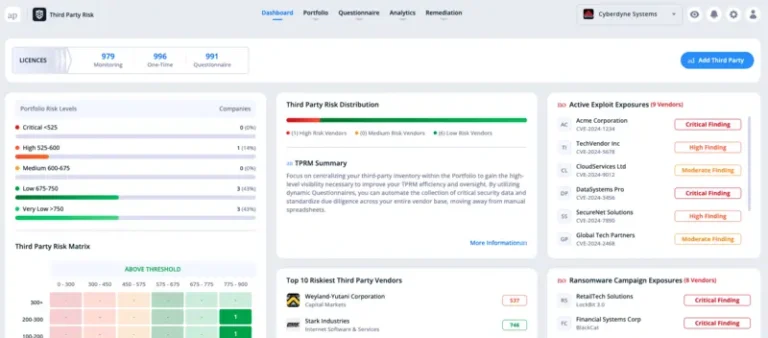
Vendor oversight shows up throughout this regulatory landscape, particularly in FFIEC’s guidance on third-party interconnectedness. FortifyData’s dedicated third-party risk management capabilities go deep on that specific problem, including continuous vendor assessment and automated questionnaire validation, useful whether that work currently sits with a security team or with whoever inherited it.

Explore FortifyData’s Third-Party Risk Management capabilities →

Beyond Risk and Compliance

IT risk and compliance are rarely the only concerns in the room at a community bank. Decisions like this one often involve more than one stakeholder, and FortifyData’s platform extends into adjacent areas that matter to the broader team, including Contract Management, which gives visibility into vendor contract inventory, contract type, expiration dates, and renewal reminders. It’s built as a hygiene layer that keeps contract data organized and visible, ensuring you monitor different types of agreements, terms and expiry dates. Nobody likes having to renew a service they meant to cancel because they were unaware of or forgot the cancellation notice period prior to the renewal date.

Right-Sized for the Way Your Team Actually Works

An examiner’s question shouldn’t be the first time your team finds out where the gaps are, and a one or two person team shouldn’t need enterprise GRC staffing to answer it.

Request a demo to see how FortifyData gives community bank risk and compliance teams one continuously current view across vendors, attack surface, and controls.

Frequently Asked Questions About IT Risk Management and Compliance Software for Community Banks

Do community banks have the same IT risk and compliance requirements as larger banks?

Yes. Regulatory expectations under GLBA Section 501(b), FFIEC guidance, and NYDFS requirements, where applicable, don’t scale down based on institution size. Community banks are held to the same substantive standard as larger institutions, typically with far fewer people to meet it.

Does GLBA require community banks to complete a risk assessment?

Yes. GLBA Section 501(b) requires a documented risk assessment. For banks, this is implemented through the Interagency Guidelines Establishing Information Security Standards, issued by the OCC, Federal Reserve, and FDIC, rather than the FTC’s Safeguards Rule, which applies to non-bank financial institutions.

Why do IT risk and compliance tasks at community banks often fall to non-IT staff?

With a one to three person security or compliance function, work gets distributed to whoever has time rather than whoever has the title. This multiple-hats pattern is well documented, including by the Federal Reserve, which has directly acknowledged the risks it creates: insufficient time allocated to the role and difficulty building broad compliance knowledge quickly.

How does FortifyData help a small compliance team manage IT risk and compliance without adding headcount?

FortifyData consolidates attack surface findings, third-party risk data, and compliance gaps into a single Risk Register, so a lean team works from one continuously updated source instead of reconciling spreadsheets, shared drives, and email threads before every exam.

Does FortifyData cover third-party and vendor risk for community banks?

Yes. FortifyData’s dedicated third-party risk management capabilities include continuous vendor assessment and automated questionnaire validation, useful whether that work currently sits with a security team or with whoever inherited it.

What other capabilities does FortifyData offer beyond IT risk and compliance?

FortifyData’s platform extends into adjacent areas like Contract Management, which gives visibility into vendor contract inventory, contract type, expiration dates, and renewal reminders, useful for stakeholders beyond the security and compliance team.

Related Resources

How next-gen AI-Powered TPRM programs are streamlining vendor risk

Watch how CTEM strategies can be implemented

Third Party Cyber Risk Management: Automating Product and Service Specific Assessments