
IT Risk Management & Compliance Software for Banks

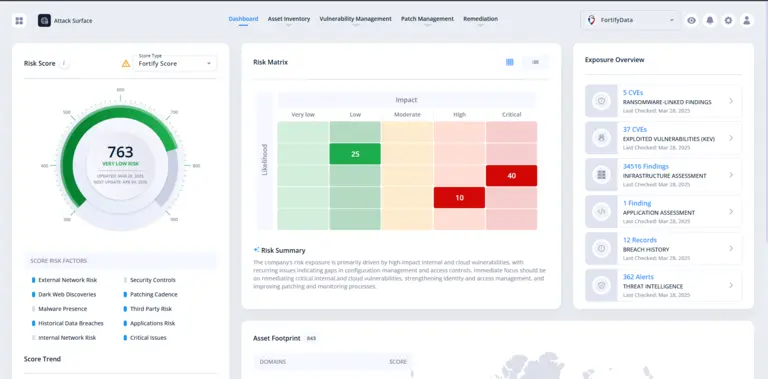
FortifyData dashboard 2026

Most banks do not discover a gap in their risk or compliance program on a quiet Tuesday. They discover it during an examination, when an examiner asks a question no one in the room can answer with full confidence. Or they discover it after an incident, when the gap becomes the finding instead of a footnote.

This page covers two things banks need and often manage separately: IT risk management, identifying and prioritizing risk before it becomes a problem, and compliance management, proving to an examiner that your controls actually meet the standard.

FortifyData IT risk management and compliance platform gives risk and compliance teams at banks a single, continuously updated view of both, so the answer to an examiner’s question is already documented, not assembled the night before.
The Regulatory Landscape Banks are Managing

Banks are operating under more overlapping regulatory attention than at any point in recent memory, in the US and, for institutions with European operations or counterparties, in the EU as well.

In the US, FFIEC guidance and NYDFS requirements have both moved toward continuous oversight expectations rather than annual snapshots, particularly around third-party interconnectedness. GLBA Section 501(b), implemented for banks through the Interagency Guidelines Establishing Information Security Standards, mandates a documented risk assessment as a distinct requirement, not a byproduct of your compliance file.

In the EU, DORA requires financial entities to maintain an ongoing, continuously monitored register of third-party ICT providers, not an annual review. NIS2 adds broader cybersecurity obligations for critical infrastructure and digital services. Both reflect the same underlying shift US regulators are already pushing toward: continuous visibility, not point-in-time assurance. (For a deeper look at DORA specifically, see DORA compliance resources).

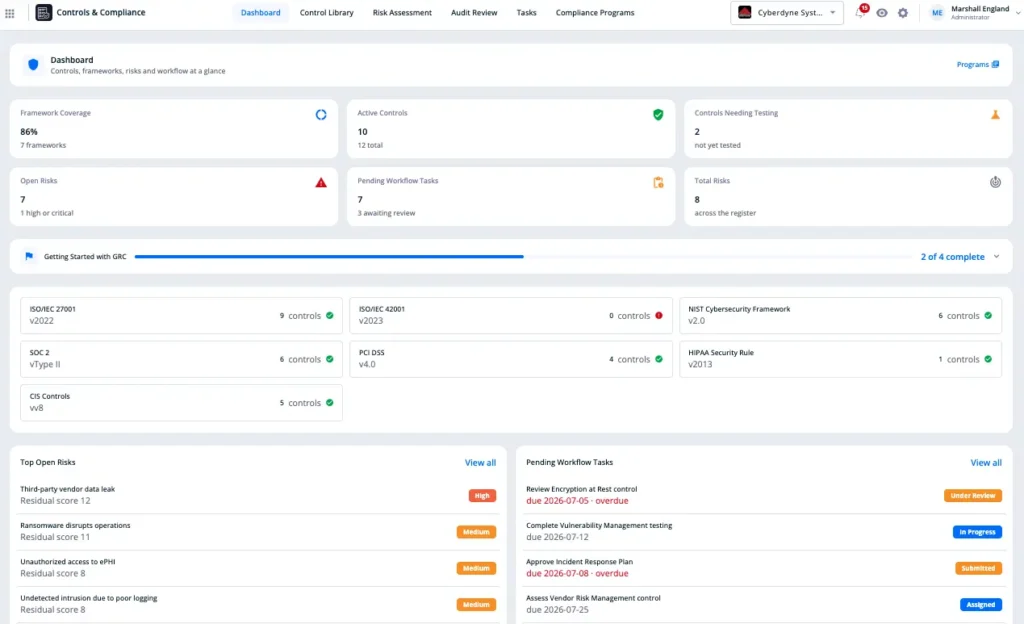
compliance management grc dashboard

Where Does Your Bank Stand Today?

Wherever your institution falls, the underlying need is the same: a program that can produce a confident answer on demand.

Where you are What this typically looks like What matters most right now
Building a program from scratch A newer or smaller institution working from templates and manual tracking A structured foundation for both risk assessment and compliance evidence that can scale
Managing US multi-regulator complexity Juggling FFIEC and NYDFS requirements in parallel, often in separate systems One consolidated view instead of reconciling multiple sources by hand
Navigating DORA and NIS2 as an EU-regulated entity New continuous-monitoring obligations for third-party ICT providers and broader cybersecurity requirements A live register that satisfies the "ongoing," not annual, standard both regulations set
Responding to an audit or exam finding An examiner has already flagged a gap and leadership wants assurance it will not happen again Continuous, documented evidence that closes the gap and demonstrates it stays closed

IT Risk Management: Know What You're Carrying Before an Examiner Asks

Under GLBA Section 501(b), implemented for banks through the Interagency Guidelines Establishing Information Security Standards, a documented risk assessment is a distinct regulatory deliverable. It is not a summary you produce from your compliance file after the fact. It is meant to reflect current risk, not last year’s risk.

Most banks still build this assessment as a static exercise, refreshed annually and disconnected from what is actually changing across the environment day to day. FortifyData’s Risk Register scores and prioritizes risk from attack surface findings, third-party assessments, and framework gaps as they emerge, so the risk assessment reflects what is true this week, not what was true at the last review cycle.

For a bank, that means the risk assessment your examiners expect is always current, because it is built from the same data your team already works from, not assembled separately for the file.

Compliance Management: Prove It, Don't Just Track It

Compliance management is a different job. It is the evidence, the audit trail, the policy documentation, and the mapping of controls to a framework, all of which need to be produced with confidence when an examiner asks for them.

FortifyData consolidates attack surface findings, third-party risk data, and framework mapping into the same Risk Register your team uses for risk assessment, so audit preparation is not a separate scramble built from spreadsheets in the weeks before an exam. Policy status, control gaps, and supporting evidence live in one place, updated continuously rather than reconstructed under deadline.

IT risk management asks Compliance management asks
What risk exists right now, and how severe is it? Can we prove our controls meet the standard an examiner will hold us to?
Where should the team focus first, based on actual exposure? Is our documentation current enough to stand behind in an exam?
What changed since the last assessment? What evidence exists for every control we claim to have?

Third-Party Risk Is Part of This, Not the Whole Story

Vendor oversight shows up throughout this regulatory landscape, from FFIEC’s third-party interconnectedness guidance to DORA’s ICT provider register. FortifyData’s dedicated third-party risk management capabilities go deep on that specific problem, including continuous vendor assessment and automated questionnaire validation.

Explore our Third-Party Risk Management Capabilities –>

Right-Sized for Community Banks

Smaller institutions face the same regulatory expectations as larger banks, typically with fewer people to meet them. Often, a one or two person team is holding the program together with spreadsheets, and the work doesn’t always sit with a dedicated security or compliance hire.

FortifyData gives a lean team the same continuous visibility a larger institution builds with a dedicated GRC staff.

See how FortifyData works for community banks specifically →

Looking for the broader financial services picture, including mortgage lenders, payment processors, and investment firms? See FortifyData for Financial Services.

See Where Your Risk & Compliance Program Actually Stands

An examiner’s question should not be the first time your team finds out where the gaps are.

Request a demo to see how FortifyData gives bank risk and compliance teams one continuously current view across controls, attack surface and vendors.

Banking IT Risk Management & Compliance Frequently Asked Questions

What is the difference between IT risk management and compliance management for banks?

IT risk management identifies, scores, and prioritizes risk before it becomes a problem. Compliance management proves to an examiner that controls meet a required standard, with documentation and evidence to support it. Banks need both, and they are not the same task.

Does GLBA require banks to complete a risk assessment?

Yes. GLBA Section 501(b) requires a documented risk assessment. For banks, this is implemented through the Interagency Guidelines Establishing Information Security Standards, issued by the OCC, Federal Reserve, and FDIC, rather than the FTC’s Safeguards Rule, which applies to non-bank financial institutions.

How does DORA affect banks with European operations?

DORA requires in-scope EU financial entities to maintain a continuously monitored register of third-party ICT providers, replacing point-in-time vendor reviews with an ongoing standard. NIS2 adds broader cybersecurity obligations for critical infrastructure and digital services.

Is FortifyData IT risk management and compliance software built for banks managing both US and EU regulatory requirements?

Yes. FortifyData IT risk management and compliance software supports banks navigating FFIEC and NYDFS requirements in the US alongside DORA and NIS2 obligations for institutions with European operations or counterparties.

How does FortifyData help with exam and audit preparation?

FortifyData consolidates attack surface findings, third-party risk data, and compliance gaps into a single Risk Register that stays current between exams, so documentation reflects real-time status instead of being assembled under deadline.

Do smaller banks need a dedicated IT risk and compliance platform?

Smaller banks face the same regulatory expectations as larger institutions, typically with fewer people to manage them. A consolidated platform gives a lean team continuous visibility without the cost or complexity of enterprise GRC software built for much larger programs.