
A security posture assessment is a technical evaluation of an organization’s actual security posture: its controls, configuration, vulnerability exposure, and readiness to respond, measured directly rather than inferred from a questionnaire or a policy binder. (For the fuller definition of security posture itself, including where it connects to compliance, see What Is Security Posture?.)
What separates a real assessment from a checklist is where the data comes from. A credible assessment is built on direct, technical evidence: what’s actually running, what’s actually exposed, and what’s actually configured, not what an organization believes or reports about itself.
What a Security Posture Assessment Actually Covers
- Attack surface and vulnerability exposure: asset discovery across an organization’s external and internal footprint, and what’s actually internet-facing and exploitable (see attack surface management)
- Cloud environments: misconfigurations, exposed storage, and least-privilege gaps specific to a cloud provider (see cloud security posture management)
- Third-party and vendor risk: the posture an organization inherits from the vendors connected to it, not just its own environment (see third-party risk management)
- Incident response readiness: whether a response plan is actually operational, not just documented
That third point is easy to underestimate. One customer, a Director of Cybersecurity Services at a U.S. mortgage lender, found that continuous monitoring surfaced a DMARC misconfiguration at one of their vendors, a real email security gap for an industry dependent on email to complete mortgage transaction, that a periodic questionnaire cycle wouldn’t have caught between review windows.
Incident response readiness deserves its own explanation, since it’s often left out of what people picture when they hear “assessment.” A response plan that exists on paper isn’t the same as a program that can actually execute one. FortifyData’s Incident Management module gives teams a centralized incident command interface, guided playbooks, and automated response workflows, so readiness is something that’s tested and operational, not just documented.
Policy and controls are also part of the picture, and the goal is connecting them to the technical reality rather than managing them as a separate exercise. FortifyData’s technical assessment findings feed into the same Risk Register used for compliance evidence (see compliance automation), so an organization can see whether its documented controls actually match what’s happening technically. That’s continuous controls monitoring, not two disconnected processes running in parallel.
Where the Real Gaps Usually Show Up
Most organizations aren’t surprised by the categories above in theory. They’re surprised by the specific things a continuous assessment turns up in practice: a vendor connection nobody remembered granting access, a cloud storage bucket that quietly went public during a configuration change, a subdomain still pointing at a decommissioned service, an incident response plan that was written two years ago and never actually tested against a real scenario.
None of these show up on an annual review’s radar until the year it’s reviewed, and by then the exposure has often existed for months.
What Continuous Scanning Surfaces, and What You Do With It
A continuous assessment surfaces the threats and vulnerabilities in an environment as they appear. What that means in practice depends on where an organization is starting from.
For a team without an existing program, this is often the first real, verified picture they’ve had, a genuine step forward from working off assumptions.
For a team that’s already been through a formal gap analysis or self-audit, the same findings read differently: less like new discovery, more like confirmation, continuous technical evidence that validates, refines, or tracks deficiencies that were already identified on paper. Either way, the value is the same kind of thing: a current, technical answer to “where do we actually stand,” rather than a stale one.
See How You Compare: Industry Benchmarking
Knowing an organization’s own posture answers one question. Knowing how that posture compares to similar organizations answers another one that’s just as natural to ask.
FortifyData compares a client’s scanning data, both the trend over time and the current score, against industry peers within the same scanning population, whether the organization is being assessed as a vendor across multiple clients or being scanned directly as a client itself.
One higher education client, for example, is consistently benchmarked against other .edu institutions on both trend and current score, giving their security team a reference point beyond “better or worse than last quarter.”
Why Continuous Beats One-Time
A one-time assessment, whether it’s a point-in-time scan or a professional-services engagement, is accurate for exactly as long as nothing changes. A new vendor connection, a configuration change, a newly exposed asset: none of these wait for the next scheduled review.
One customer at D’Youville University described the gap this fills directly: the capabilities they needed were normally scattered across three or four separate tools, and consolidating them into one continuous platform “delivered what others just claimed.”
Where Does Your Organization Fall?
Security maturity tends to follow a recognizable progression, whether an organization is being formally scored against a framework or just being honest about where it stands. Wherever an organization sits on this spectrum, the underlying need is the same: a program that can produce a confident answer on demand.
| Level | Maturity Stage | What This Typically Looks Like | What Matters Most Right Now |
|---|---|---|---|
| 1 | Unstructured | Security decisions are made reactively, based on assumption rather than verified data | A real baseline of what's actually exposed |
| 2 | Repeatable | A one-time assessment or pen test has happened, but nothing since; findings live in a report, not a live process | Visibility into what's changed since that snapshot was taken |
| 3 | Standardized | Policies and controls are documented and applied consistently, but validation is manual, and vendor risk is tracked separately from internal risk | A unified, technical view that confirms documented controls match reality |
| 4 | Managed and Monitored | Posture is actively tracked and findings are prioritized, but proving progress to an auditor, examiner, or board still takes real manual effort | Evidence that's already assembled and defensible, not reconstructed under deadline |
| 5 | Optimized | Assessment, benchmarking, and reporting run continuously with minimal manual effort; findings feed directly into remediation and compliance workflows | Sustaining that continuous state as the environment and vendor list keep changing |
See Where Your Security Posture Actually Stands
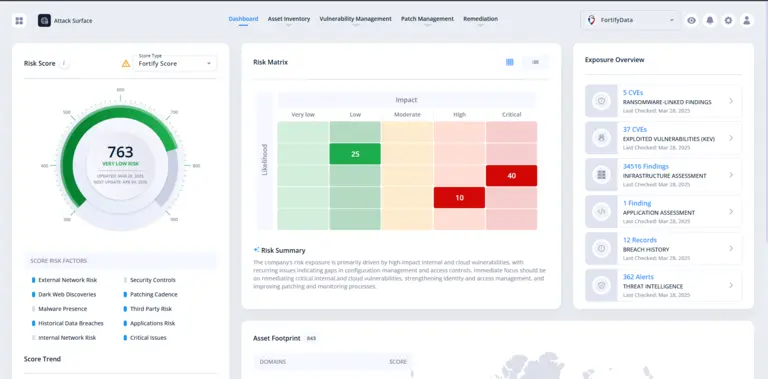
A security posture assessment is only as useful as how current it stays. FortifyData runs that assessment continuously, across an organization’s technical environment, cloud infrastructure, and vendor ecosystem, so the picture stays accurate as things change rather than going stale the day the report is filed. (For organizations that want a professional-services layer on top of the platform, that’s also available through FortifyData’s partner ecosystem of MSPs, MSSPs, and vCISOs.)
Request a Free Assessment to see where your organization actually stands.
Frequently Asked Questions about Security Posture Assessments
What does a security posture assessment cover?
Attack surface and vulnerability exposure, cloud environment configuration, third-party and vendor risk, incident response readiness, and policy and controls, connected to the technical evidence behind them.
How is a continuous assessment different from a one-time security assessment or pen test?
A one-time assessment is accurate for as long as nothing changes. A continuous assessment catches what happens after that, a new vendor connection, a configuration change, a newly exposed asset, as it happens rather than at the next scheduled review.
How does FortifyData handle incident response as part of an assessment?
Through the Incident Management module: a centralized incident command interface, guided playbooks, and automated response workflows, so response readiness is operational, not just documented.
Can I compare my security posture to other organizations in my industry?
Yes. FortifyData benchmarks a client’s scanning data, both trend over time and current score, against industry peers within the same scanning population.

