Cloud Security Posture Management

Cloud environments change constantly. New resources are provisioned, configurations drift, permissions expand beyond what was intended, and storage buckets get exposed. Most organizations discover these gaps during an audit, after a compliance examination, or after an incident. None of which are good moments to find out that a misconfigured cloud environment was the entry point.

Cloud Security Posture Management is the continuous monitoring discipline that closes this gap. Rather than periodic point-in-time assessments, CSPM keeps a live view of cloud configuration risk, identifying misconfigurations, compliance violations, and exposure before they become incidents.

FortifyData’s CSPM capability monitors AWS, Azure, Google Cloud, and Oracle Cloud continuously, surfaces prioritized findings based on actual risk rather than raw finding count, and integrates cloud posture data into the same risk management platform as your external attack surface, vendor risk, and compliance program. Cloud risk does not exist in isolation, and neither should the tool that monitors it.

What Cloud Security Posture Management Does

CSPM addresses a specific and persistent problem in cloud security: the gap between how a cloud environment is supposed to be configured and how it actually is at any given moment.

Cloud teams move fast. Infrastructure is spun up by developers, modified by operations, and configured by multiple teams across multiple accounts. Each change creates the potential for a misconfiguration, an exposed storage bucket, an overprivileged IAM role, an unencrypted database, a network security group that allows too much inbound traffic. Without continuous monitoring, these misconfigurations accumulate silently until something external surfaces them.

CSPM continuously scans cloud accounts, discovers all resources across environments, and evaluates each resource against security best practices and compliance framework requirements. When a misconfiguration is detected, or when a previously compliant configuration drifts out of compliance, the platform flags it, prioritizes it by risk severity, and provides actionable guidance for remediation.

The result is a continuously current view of cloud security posture rather than a quarterly snapshot that is outdated before the report is finished.

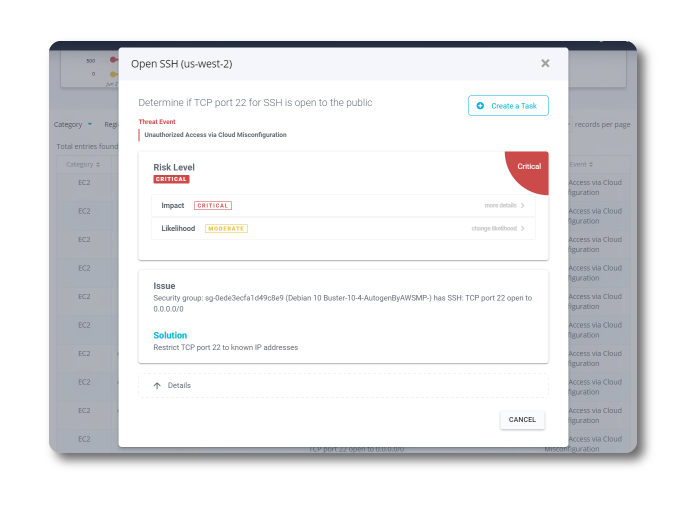
FortifyData’s cloud-focused dashboard provides an easy-to-understand view of your cloud infrastructure across AWS, Azure, Google Cloud, and Oracle Cloud. Plus, we provide actionable recommendations to continuously improve your cloud security posture.

What FortifyData Monitors

FortifyData’s CSPM continuously scans cloud environments across AWS, Azure, Google Cloud, and Oracle Cloud, covering the misconfiguration categories that most commonly create exploitable exposure:

Identity and access management. Overprivileged IAM roles, missing MFA enforcement, poor password policies, and access keys that have not been rotated. IAM misconfigurations are the most common initial access vector in cloud breaches, and monitoring them continuously is the foundation of cloud posture management.

Data storage exposure. Unencrypted storage, publicly accessible buckets or blobs, misconfigured backup and restore settings, and data residency violations. Storage misconfigurations have been behind some of the most consequential cloud data exposures in recent years.

Network security. Security groups and network ACLs that allow overly permissive inbound or outbound traffic, open ports that expose services unnecessarily, and network configurations that do not enforce least-privilege principles at the infrastructure layer.

Compute and workload configuration. Misconfigured virtual machines, serverless functions, and container environments, including missing security agents, outdated images, and privilege escalation paths.

Encryption and key management. Unencrypted data at rest and in transit, weak encryption configurations, and key management practices that do not meet compliance framework requirements.

Compliance framework violations. Findings are automatically mapped to relevant control requirements including NIST CSF, CIS Benchmarks, PCI DSS, HIPAA, and GDPR, so misconfiguration remediation connects directly to your compliance management program rather than existing as a separate tracking exercise.

Cloud Risk Prioritization, Not Just a Finding List

The practical challenge with CSPM is not finding misconfigurations. Cloud environments generate more findings than any team can remediate simultaneously. The challenge is knowing which findings to fix first.

FortifyData’s CSPM applies contextual risk scoring to each finding rather than treating every misconfiguration as equally urgent. Severity is assessed based on exploitability, the sensitivity of the affected resource, exposure to the public internet, and whether the misconfiguration creates a path to data or systems that would be most damaging if compromised. High-severity findings surface at the top of the remediation queue alongside actionable guidance, with specific steps to correct the configuration rather than just a description of what is wrong.

The result is a prioritized workplan rather than an undifferentiated list of hundreds of findings that consume analyst time without producing proportional risk reduction.

Cloud Posture in Context: The Consolidation Advantage

A standalone CSPM tool answers one question: what is misconfigured in my cloud environments right now? That is a useful answer. But it is an incomplete picture of cloud risk when it exists in isolation from the rest of the attack surface.

A misconfigured cloud storage bucket matters more when it is also a vendor-accessible environment invoking your third-party risk management program. A cloud IAM vulnerability matters more when the external attack surface scan shows exposed management interfaces in the same environment. A compliance gap in cloud configuration has different urgency depending on whether the organization is under active regulatory examination.

FortifyData’s CSPM feeds cloud posture findings into the same risk platform as external attack surface management, third-party risk monitoring, internal risk assessments, and compliance management. Cloud risk is visible in the same dashboard as vendor risk and external exposure, not in a separate tool that requires a separate login, a separate workflow, and manual reconciliation with the rest of the security program.

For security teams already using FortifyData for ASM or TPRM, adding CSPM does not mean adding another tool. It means adding another data source to the risk view that is already there.

Regulatory Relevance

Cloud security posture is increasingly a specific regulatory requirement for financial services organizations, not just a best practice.

DORA (Digital Operational Resilience Act) applies to financial services entities operating in the EU and requires continuous monitoring of ICT infrastructure including cloud environments, with documented evidence of configuration management and risk controls.

NYDFS Cybersecurity Regulation requires covered entities to maintain policies governing cloud services and demonstrate ongoing assessment of cloud security controls as part of their cybersecurity program.

HIPAA Security Rule changes expected to take effect in 2027 address cloud-hosted electronic protected health information explicitly a direct concern for healthcare organizations, requiring technical controls and ongoing monitoring of cloud environments where patient data is stored or processed.

FFIEC guidance on cloud computing requires financial institutions to assess and monitor cloud service provider configurations as part of their technology risk management programs.

In each of these regulatory environments, point-in-time cloud assessments are not sufficient. Examiners and auditors increasingly expect continuous monitoring evidence. FortifyData’s CSPM provides that continuous monitoring alongside the compliance and GRC automation needed to demonstrate posture against the specific framework the regulator requires.

How FortifyData's CSPM Fits the Broader Platform

FortifyData is a consolidated cyber risk management platform covering attack surface management, third-party risk management, compliance automation, and cloud security posture management in one system. CSPM is one component of that consolidated view, not a standalone product.

For organizations evaluating dedicated CSPM tools alongside separate ASM and TPRM platforms, the consolidation argument is straightforward. FortifyData provides continuous cloud posture monitoring, external attack surface management, vendor risk monitoring, internal risk assessments and compliance management from a single platform with a single data model. Cloud findings, external exposure findings, and vendor risk findings all feed into the same risk register, reducing the integration work, the reconciliation effort, and the tool sprawl that comes with managing separate point solutions for each function.

Frequently Asked Questions About Cloud Security Posture Management

What is Cloud Security Posture Management (CSPM)?

Cloud Security Posture Management is the continuous monitoring and assessment of cloud infrastructure configurations to identify misconfigurations, compliance violations, and security risks before they result in incidents or regulatory findings. CSPM tools scan cloud accounts across providers such as AWS, Azure, and Google Cloud, evaluate each resource against security best practices and compliance framework requirements, and surface prioritized findings with remediation guidance. Unlike periodic cloud security assessments, CSPM operates continuously so that configuration drift and new misconfigurations are detected as they occur rather than discovered during an audit.

What cloud environments does FortifyData’s CSPM monitor?

FortifyData monitors AWS, Azure, Google Cloud, and Oracle Cloud continuously for misconfigurations, compliance violations, and security posture risks. Findings are surfaced in a unified risk dashboard alongside external attack surface and vendor risk data, providing a consolidated view of cloud and non-cloud exposure in a single platform.

How does CSPM relate to Attack Surface Management?

ASM and CSPM address adjacent but distinct problems. External ASM discovers and monitors internet-facing assets including domains, IP addresses, exposed services, and unknown assets for vulnerabilities and exposures visible from outside the organization. CSPM monitors the internal configuration of cloud environments including IAM policies, storage settings, encryption configuration, and network security groups for misconfigurations that create risk regardless of external exposure. FortifyData integrates both capabilities in the same platform so cloud configuration risk and external attack surface exposure are visible together rather than in separate tools.

Does FortifyData’s CSPM map findings to compliance frameworks?

Yes. FortifyData maps cloud security posture findings to relevant compliance framework controls including NIST CSF, CIS Benchmarks, PCI DSS, HIPAA, and GDPR. This means misconfiguration findings connect directly to the compliance controls they affect, providing a clear view of which findings have regulatory implications and which are security best practice violations without a direct compliance framework mapping.

What types of misconfigurations does FortifyData’s CSPM detect?

FortifyData detects misconfigurations across IAM and access management including overprivileged roles, missing MFA, and unrotated access keys; data storage including unencrypted storage, publicly accessible buckets, and misconfigured backups; network security including overpermissive security groups and unnecessary open ports; compute configuration including misconfigured virtual machines and serverless functions; and encryption and key management. Findings are risk-scored and prioritized so security teams focus remediation effort on the highest-severity issues first.

How is FortifyData’s CSPM different from standalone CSPM tools?

Standalone CSPM tools provide cloud configuration monitoring in isolation. FortifyData’s CSPM integrates cloud posture findings into the same platform as external attack surface management, third-party risk monitoring, and compliance management. Cloud risk is visible alongside vendor risk and external exposure in a unified risk register rather than a separate tool requiring separate workflows and manual reconciliation with the rest of the security program. For organizations already managing ASM or TPRM through FortifyData, CSPM adds cloud posture visibility without adding another tool.