RealCISO is a compliance intelligence platform built for MSPs, MSSPs, and vCISO consultancies who need to run security assessments, track compliance maturity, and deliver audit-ready documentation across a growing client book. It handles the structured compliance delivery work well, including framework assessments, maturity tracking, remediation workflows, and client reporting. Its AI reasoning engine, Cleo, adds genuine intelligence to the compliance management layer. For the vCISO whose primary engagement is helping a client prepare for a SOC 2 audit, achieve CMMC compliance, or satisfy a cyber insurance requirement, RealCISO provides a capable platform for managing that process.
RealCISO is a product of SideChannel, a managed security services company.
Where RealCISO has a meaningful gap is the technical layer beneath the compliance management. The platform does not perform independent technical scanning. It manages and documents security programs built on data from integrations and questionnaires. Automated continuous monitoring of compliance controls, the kind that verifies whether controls remain in effect without manual check-ins, is on their 2026 roadmap rather than available today. For a vCISO whose clients need to know what their actual technical exposure looks like, not just how their controls map against a framework, that gap is significant.
This page is for vCISOs and MSPs evaluating whether RealCISO’s compliance intelligence approach fits their practice, and where FortifyData fits as an alternative or complement.
What RealCISO Does
RealCISO positions itself as a compliance intelligence platform rather than compliance software. The distinction is that it builds a connected data graph across Controls, Risks, Evidence, Vendors, Policies, and People, rather than storing flat question-and-answer rows. That architecture enables capabilities that simpler compliance tools cannot match: maturity trajectory tracked per control over time, impact simulation before committing remediation resources, and portfolio-level intelligence across an entire client book.
The platform is built for the compliance-led vCISO engagement. A client needs to pass a SOC 2 audit, meet CMMC requirements, satisfy HIPAA obligations, or respond to an insurance carrier’s security questionnaire. The vCISO is hired to manage that process. RealCISO automates the assessment, tracks controls against the relevant framework, manages evidence collection, and produces the documentation the audit requires. It supports 25+ compliance frameworks including NIST CSF 2.0, HIPAA 2.0, SOC 2, ISO 27001, CMMC, CIS Controls, PCI-DSS, and FedRAMP, with multi-framework single assessment capability so one evidence set maps to multiple frameworks simultaneously.
Their Cleo AI agent reasons over the entire compliance data graph, understanding gaps, generating remediation workflows, auto-linking evidence to controls, and producing board-ready risk summaries grounded in actual project data rather than generic templates. Portfolio intelligence gives MSPs cross-client pattern recognition: identifying which control categories are weakest across a specific client industry, which clients have aging evidence approaching expiration, and where remediation effort will produce the most score improvement before an upcoming audit.
For an MSP building a compliance-oriented vCISO practice, particularly one managing a large number of clients simultaneously, RealCISO’s assessment throughput, maturity tracking, and portfolio intelligence are genuinely well-developed capabilities.
Where RealCISO Has Limitations
No native technical scanning. RealCISO does not perform direct attack surface management scanning of client or vendor environments. Technical data enters the platform through integrations including AWS, GCP, Azure, Rapid7, QRadar, and Microsoft Secure Score, not from independent assessment. A vCISO using RealCISO cannot generate original live findings. They work with data from tools already running in the client environment, which means their assessment is only as current and complete as those integrations.
This is a separate limitation from continuous monitoring of compliance controls. The absence of native scanning means RealCISO cannot independently assess what is running in a client environment, regardless of how frequently compliance controls are verified.
Automated compliance control monitoring is not yet available. RealCISO has acknowledged on G2 that continuous monitoring is on their 2026 roadmap (as stated on G2). In this context, continuous monitoring refers to automated verification that controls remain in effect between assessment cycles, rather than manual check-ins. Today the platform is assessment and maturity tracking oriented. For a vCISO whose clients face ongoing regulatory scrutiny, the absence of automated control verification between assessments is worth factoring into the evaluation.
No external attack surface management. Based on publicly available product documentation, RealCISO does not include capabilities to identify unknown client assets, monitor external exposure continuously, or generate findings from an independent scan of a client’s internet-facing infrastructure. The pre-sales use case, walking into a prospect meeting with live findings before a contract is signed, is not available through RealCISO.
TPRM is questionnaire and evidence management based. RealCISO includes a TPRM module, but vendor assessment relies on questionnaires and evidence collection rather than direct technical scanning of vendor environments. The gap between what a vendor self-reports and what a direct technical assessment reveals is not visible in a questionnaire-dependent process. For vendors where RealCISO integrations are not deployed, vendor assessment relies on questionnaires and self-reported evidence rather than direct technical scanning of vendor environments.
Integration friction at scale. The most common user complaint in G2 reviews is integration issues with other tools and limited regional segmentation. For an MSP running a diverse client tool stack across multiple geographies, integration friction adds operational overhead that compounds as client count grows.
Steeper learning curve. Multiple G2 reviewers noted complexity and a learning curve, particularly for teams navigating custom compliance requirements. For practices that need any team member to deliver vCISO outcomes quickly, the onboarding investment is worth factoring in.
Also evaluating Cynomi or GetCybr? See how Cynomi compares to FortifyData and how GetCyber compares to FortifyData.
The Compliance-Led vCISO Engagement and What Is Missing
Both RealCISO and Cynomi are built for the same primary engagement model: an MSP or vCISO whose client needs to meet a compliance requirement. A small financial services firm preparing for a SOC 2 audit. A healthcare organization managing HIPAA obligations. A defense contractor pursuing CMMC certification. The vCISO is hired to manage the compliance process, assessing the current state, identifying gaps, tracking remediation, and producing the documentation the audit or examiner requires.
This is real work and it creates real value. The platforms built for it handle the compliance management layer well. What neither does is produce the technical data that compliance programs are supposed to be based on.
A compliance program that documents controls without knowing whether those controls are technically implemented and functioning is producing documentation, not security. Regulators and examiners increasingly understand this distinction. FFIEC examiners ask not just whether a TPRM program exists but whether it produces continuous monitoring data. NYDFS enforcement actions have cited the absence of technical monitoring as a distinct deficiency from the absence of a documented program. The gap between having a framework and having current technical data showing actual posture against that framework is exactly where regulatory exposure lives.
FortifyData serves the same compliance-led engagement and closes that gap. The risk and compliance module handles framework assessments, gap analysis, policy management, and continuous controls monitoring. The technical layer, including direct scanning, continuous ASM, and vendor monitoring, feeds that compliance module with live data rather than relying on what integrations or questionnaires provide. The compliance program is built on technical findings, not alongside them.
One Platform vs. A Compliance Tool Plus Scanner
A vCISO using RealCISO is managing a sophisticated compliance platform. They still need a scanning platform to tell them what their clients’ environments actually look like. Those are two separate tools, two separate data sources, and the reconciliation between what the scanner found and what the compliance platform documents is manual work that compounds with every client added.
FortifyData consolidates both functions. Direct scanning, including external attack surface management, continuous vendor monitoring for third-party risk management, internal assessment, and cloud security posture management, and compliance management, including framework assessments, gap analysis, remediation planning, and continuous controls monitoring, exist in the same platform. Findings from the technical layer flow directly into the compliance module. There is no reconciliation step because there is no second tool.
For a vCISO managing multiple client engagements, that consolidation reduces operational overhead per client and produces a more defensible compliance output, because the compliance documentation is grounded in scan data rather than imported from a separate system.
How FortifyData Fits the vCISO Use Case
FortifyData is an automated cyber GRC platform covering attack surface management, third-party risk management, and compliance automation in one system. vCISOs and MSSPs use it both for compliance-led engagements and for technical security delivery that compliance-only platforms cannot support.
Compliance management built in. FortifyData’s risk and compliance module handles framework assessments, gap analysis, policy management, and continuous controls monitoring, the same compliance delivery function RealCISO provides, integrated with the technical findings the platform generates directly.
AI Auditor against any framework. FortifyData’s AI Auditor accepts any vendor document, including SOC 2 reports, penetration tests, ISMS documentation, and any evidence artifact, and audits it against any compliance framework the user specifies. Not a predefined library. HIPAA, NIST 800-53, NIST CSF, SOC 2 Trust Service Principles, HECVAT, CMMC, or a jurisdiction-specific regulation not available in any standard library. The framework is the client’s choice, not a platform constraint.
Remediation planning grounded in technical data. FortifyData’s remediation planning ranks open gaps by risk impact and projected improvement, the same what-if analysis function RealCISO’s impact simulation provides, with the difference that FortifyData’s rankings are informed by live scan data rather than framework assessment alone. The prioritization reflects actual technical exposure, not just documented control gaps.
ASM as a pre-sales tool. FortifyData’s external attack surface management scans continuously. vCISOs use this to generate live findings before a prospect contract is signed, showing actual exposed assets, misconfigured services, and vulnerability data from a direct scan. RealCISO cannot produce this. It is one of the most differentiated capabilities for vCISOs who compete on the quality of their technical findings rather than the quality of their framework documentation.
Continuous vendor monitoring. FortifyData directly scans vendor environments rather than managing a questionnaire process. Vendor posture is assessed from live technical data. The platform auto-detects third parties from live ASM scan data and maps fourth-party concentration risk across a client’s vendor ecosystem. Continuous monitoring is live today, not on a roadmap.
Portfolio view across client book. FortifyData’s portfolio management capability provides a consolidated view of risk posture across multiple client engagements without switching between accounts, comparable to RealCISO’s portfolio intelligence, grounded in technical scan data rather than framework assessment data alone.
Integration marketplace. FortifyData integrates with the security tools already running in client environments, including Microsoft Defender, CrowdStrike Falcon, Tenable Nessus, SentinelOne, and major cloud platforms, consolidating findings into a single risk view without requiring duplicate data entry or manual reconciliation.
White-label and co-brand capability. Interface and reports can be white-labeled or co-branded. Live with MSP clients today.
Cloud security posture management. AWS, Azure, Oracle, IBM, and Google cloud environments monitored continuously alongside external and internal assets.
vCISO and MSSP partner program. FortifyData works with vCISOs and MSSPs through a dedicated partner program. vCISOs interested in delivering FortifyData’s capabilities to their clients can learn more about the vCISO partner program.
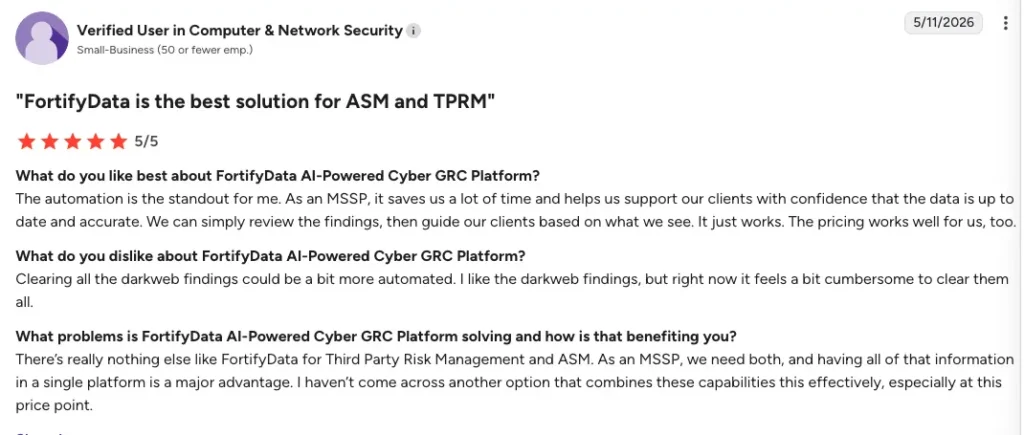
Here’s how one MSSP described it:
RealCISO vs. FortifyData - Side by Side Comparison
| Capability | RealCISO | FortifyData |
|---|---|---|
| Compliance framework assessment | ✓ Yes — 25+ frameworks, core strength | ✓ Yes — risk and compliance module |
| Compliance framework flexibility | ● 25+ predefined frameworks | ✓ Any framework via AI Auditor |
| L1-L5 maturity trajectory per control | ✓ Yes — tracked over time | ● Continuous controls monitoring |
| Impact simulation / remediation planning | ✓ Yes — simulate_project | ✓ Yes — risk-prioritized remediation planning |
| AI reasoning engine | ✓ Yes — Cleo, compliance data graph | ✓ Yes — AI Auditor, any framework |
| Multi-framework single assessment | ✓ Yes | ✓ Yes |
| Portfolio intelligence across clients | ✓ Yes — cross-client pattern recognition | ✓ Yes — portfolio view across client book |
| Native technical scanning | ✗ No — integration dependent | ✓ Yes — direct, non-intrusive scanning |
| Automated compliance control monitoring | ✗ Roadmap — 2026 | ✓ Yes — continuous controls monitoring live today |
| External attack surface management | ✗ No | ✓ Yes — continuous |
| Pre-sales scanning for prospect engagements | ✗ No | ✓ Yes |
| TPRM methodology | ● Questionnaire and evidence management | ✓ Direct vendor scanning plus questionnaire cross-validation |
| Fourth-party risk mapping | ✗ No | ✓ Yes |
| Integration marketplace | ✓ Yes — cyber marketplace | ✓ Yes — cyber security integrations marketplace |
| Cyber insurance dashboard | ✓ Yes | ✗ No |
| White-label capability | ✓ Yes — custom domain, logo, billing | ✓ Yes — interface and reports |
| Client-facing reporting | ✓ Yes | ✓ Yes — audit-ready outputs |
Which vCISO Platform Fits Your Practice
RealCISO is likely the stronger fit if: Your vCISO practice is primarily compliance program delivery, covering framework assessments, maturity tracking, audit documentation, and evidence management across a large client book. You already have scanning tools in your client environments and need a sophisticated compliance intelligence layer to manage, track, and report on what those tools find. You need cyber insurance dashboard capability as part of your service delivery model.
FortifyData is likely the stronger fit if: You want one platform that covers both the technical assessment layer and the compliance management layer without reconciling data between two systems. Your clients are in regulated industries where examiners evaluate technical monitoring data separately from documented compliance programs, and you need both from the same source. Your differentiation as a vCISO is the quality of live technical findings you bring to clients and prospects, not just the quality of the compliance documentation you produce around them. You need continuous vendor monitoring today, not on a roadmap.
The consolidation case: If you are currently running RealCISO alongside a separate scanning tool, FortifyData consolidates both functions. Technical scanning, including ASM, vendor monitoring, internal assessment, and cloud security posture, and compliance management, including framework assessments, gap analysis, remediation planning, and continuous controls monitoring, exist in one platform, with findings that flow directly into the compliance layer rather than requiring manual reconciliation between systems.
See how FortifyData can help your vCISO program and book a demo.
Frequently Asked Questions about RealCISO Alternatives
What is the main difference between RealCISO and FortifyData?
RealCISO is a compliance intelligence platform that tracks security maturity, manages evidence, and runs framework assessments across a multi-client book. It builds a connected data graph across controls, risks, evidence, vendors, policies, and people, and its AI engine reasons over that structure. FortifyData is a consolidated cyber risk management platform that adds the technical layer RealCISO cannot provide: direct scanning of client and vendor environments, continuous external attack surface monitoring, and compliance management grounded in live scan data. RealCISO manages compliance programs built on data from other tools. FortifyData generates the technical data and manages the compliance program in the same platform.
Does RealCISO include continuous monitoring?
Not fully. RealCISO has acknowledged on G2 that continuous monitoring is on their 2026 roadmap. In compliance platform terms, continuous monitoring typically refers to automated verification that security controls remain in effect between assessment cycles, rather than manual periodic check-ins or technical scanning of environments. Today RealCISO is built around assessment cycles, maturity tracking, and evidence management. FortifyData’s continuous controls monitoring is live today, alongside continuous technical scanning capabilities that are a separate and distinct function from compliance control verification.
Does FortifyData work for vCISOs managing compliance-led client engagements?
Yes. FortifyData’s risk and compliance module handles framework assessments, gap analysis, policy management, and continuous controls monitoring. The AI Auditor audits vendor documents and evidence against any compliance framework the user specifies, including frameworks not available in predefined libraries. For vCISOs whose clients need SOC 2, HIPAA, CMMC, NIST CSF, or other framework compliance, FortifyData covers that work alongside the technical scanning layer.
Does RealCISO perform technical scanning of client environments?
No. RealCISO’s technical data comes from integrations with existing tools in the client environment, including AWS, GCP, Azure, Rapid7, QRadar, and Microsoft Secure Score, rather than from independent direct scanning. A vCISO using RealCISO cannot generate original live findings independently of the tools already running in the client environment.
Can FortifyData white-label its platform for MSP and vCISO delivery?
Yes. FortifyData supports white-label and co-brand capability across both the platform interface and reporting outputs. This capability is live with MSP clients today.
What compliance frameworks does FortifyData support?
FortifyData’s AI Auditor audits vendor documents and evidence against any compliance framework the user specifies, including HIPAA, NIST 800-53, NIST CSF, SOC 2 Trust Service Principles, HECVAT, ISO 27001, CMMC, and jurisdiction-specific regulations not available in predefined framework libraries. The framework is the client’s choice, not a platform constraint.
Comparison information reflects publicly available sources as of June 2026.